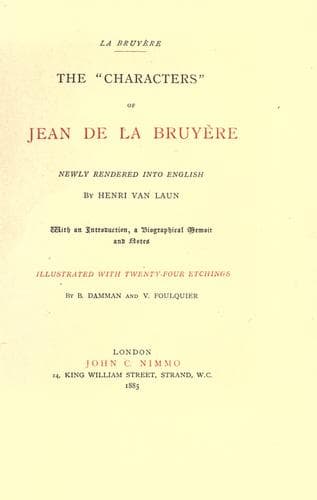
The "Characters" of Jean de La BruyèreLa Bruyère, Jean de
General
The "Characters" of Jean de La Bruyère
La Bruyère, Jean de
Character sketches -- Early works to 1800; Characters and characteristics
(65.) We often pretend that a witticism is our own, and by doing this
we run the risk of destroying its effect; it falls flat, and witty
people, or those who think themselves so, receive it coldly, because
they ought to have said it, and did not. On the contrary, if told as
anotherʼs, it would meet with a better reception; it is but a jest
which no one is obliged to know; it is related in a more insinuating
manner, and causes less jealousy; it offends nobody; if it is amusing
it is laughed at, and if excellent is admired.
(66.) Socrates was said to be insane, to be “an intelligent madman;”
but those Greeks who gave such a name to so wise a man passed for
madmen themselves. They exclaimed, “What odd portraits does this
philosopher present us with! What strange and peculiar manners does he
describe! In what dreams did he discover and collect such extraordinary
ideas! What colours and what a brush has he! They are only idle
fancies!” They were mistaken—all those monsters and vices were painted
from life, so that people imagined they saw them, and were terrified.
Socrates was far from a cynic; he did not indulge in personalities, but
lashed the morals and manners which were bad.[643]
(67.) A man who has acquired wealth by his knowledge of the world is
acquainted with a philosopher, and with his precepts, morals, and
conduct; but not imagining that mankind can have any other goal in
whatever they do than the one he marked out for himself during his
whole lifetime, he says in his heart, “I pity this rigid critic; his
life has been a failure; he is on a wrong track, and has lost his way;
no wind will ever waft him to a prosperous harbour of preferment;” and,
according to his own principles, he is right in his arguments.
Antisthius says: “I pardon those I have praised in my works, if they
will forget me, for I did nothing for them, as they deserved to be
commended. But I will not so easily pardon forgetfulness in those whose
vices I have attacked, without touching their persons, if they owe
me the invaluable boon of being amended; but as such an event never
happens, it follows that neither the one nor the other are obliged to
make me any return.”
This philosopher continued saying: “People may envy my writings or
refuse them their reward, but they are unable to diminish their
reputation; and if they did, what should hinder me from scorning their
opinions?”
(68.) It is a good thing to be a philosopher, but it does not much
benefit a man to be thought one. It will be considered an insult to
call any one a philosopher till the general voice of mankind has
declared it otherwise, given its true meaning to this beautiful word,
and granted it all the esteem it deserves.
Public-domain text, read in full here on John Shaqi.
Reviews
Reviews
No reviews yet
Be the first to share your thoughts on this work.
Elsewhere in the archive
Join the Discussion
Join the discussion
Sign in to leave a comment or review.
Sign InorCreate an account