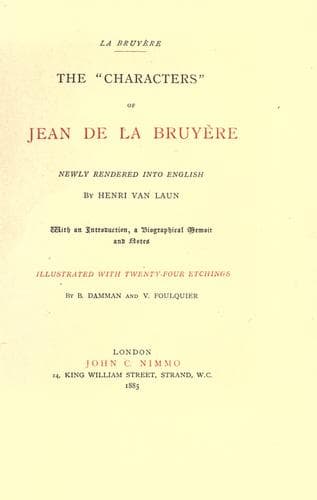
The "Characters" of Jean de La BruyèreLa Bruyère, Jean de
General
The "Characters" of Jean de La Bruyère
La Bruyère, Jean de
Character sketches -- Early works to 1800; Characters and characteristics
(69.) There is a philosophy which raises us above ambition and
fortune, and not only makes us the equals of the rich, the great, and
the powerful, but places us above them; makes us contemn office and
those who appoint to it; exempts us from wishing, asking, praying,
soliciting, and begging for anything, and even restrains our emotion
and our excessive exultation when successful. There is another
philosophy which inclines and subjects us to all these things for the
sake of our relatives and friends; and this is the better of the two.
(70.) It will shorten and rid us of a thousand tedious discussions
to take it for granted that some persons are not capable of talking
correctly, and to condemn all they have said, do say, or will say.
(71.) We only approve in others those qualities in which we imagine
they resemble us; thus, to esteem any one seems to make him an equal of
ourselves.
(72.) The same faults which are dull and unbearable in others are in
their right place when we have them; they do not weigh us down, and are
hardly felt. One man, speaking of another, draws a terrible likeness
of him, and does not in the least imagine that at the same time he is
painting himself.
If we could see the faults in other people, and could be brought to
acknowledge that we possess the same faults, we would more readily
amend them; it is when we are at a right distance from them, and when
they appear what they really are, that we dislike them as much as they
deserve.
(73.) A wise manʼs behaviour turns on two pivots, the past and the
future. If he has a good memory and a keen foresight, he runs no
danger of censuring in others what perhaps he has done himself,
or of condemning an action which, in a parallel case, and in like
circumstances, he sees it will be impossible for him to avoid.
(74.) Neither a soldier, a politician, nor a skilful gambler[644]
create luck, but they prepare it, allure it, and seem almost to fix it.
They not only know what a fool and a coward ignore, I mean, to make use
of luck when it does come, but by their precautions and measures they
know how to take advantage of a lucky chance, or of several chances
together. If a certain deal or throw succeeds, they gain; if another
happens, they also win; and often profit by one and the same in various
ways. These sharp men may be commended both for their good fortune and
prudent conduct, and they should be rewarded for their luck as other
men are for their virtue.
(75.) I place nobody above a great politician but a man who does not
care to become one, and who is more and more convinced that it is not
worth troubling himself about what is going on in the world.
(76.) In the best of counsels there is something to displease us; they
are not our own thoughts; and, therefore, presumption and caprice at
first cause them to be rejected, whilst we only follow them through
necessity or after having reflected.
Public-domain text, read in full here on John Shaqi.
Reviews
Reviews
No reviews yet
Be the first to share your thoughts on this work.
Elsewhere in the archive
Join the Discussion
Join the discussion
Sign in to leave a comment or review.
Sign InorCreate an account