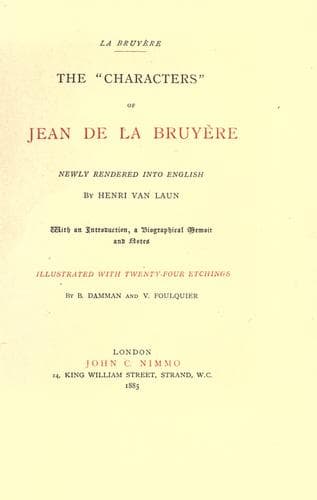
The "Characters" of Jean de La BruyèreLa Bruyère, Jean de
General
The "Characters" of Jean de La Bruyère
La Bruyère, Jean de
Character sketches -- Early works to 1800; Characters and characteristics
(8.) A fashionable person is like a certain blue flower which grows
wild in the fields, chokes the corn, spoils the crops, and takes up the
room of something better; it has no beauty nor value but what is owing
to a momentary caprice, which dies out almost as soon as sprung up.
To-day it is all the rage, and the ladies are decked with it; to-morrow
it is neglected and left to the common herd.[709]
A person of merit, on the contrary, is a flower we do not describe by
its colour, but call by its name, which we cultivate for its beauty
or fragrance, such as a lily or a rose; one of the charms of nature,
one of those things which beautify the world, belonging to all times,
admired and popular for centuries, valued by our fathers, and by us in
imitation of them, and not at all harmed by the dislike or antipathy of
a few.
(9.) Eustrates is seated in his small boat, delighted with the fresh
air and a clear sky; he is seen sailing with a fair wind, likely to
last for some time, but a lull comes on all of a sudden, the sky
becomes overcast, a storm bursts forth, the boat is caught by a
whirlwind, and is upset. Eustrates rises to the surface of the waters
and exerts himself; it is to be hoped he will at least save himself and
get hold of the boat; but another wave sinks him, and he is considered
lost: a second time he appears above the water, and hope revives, when
a billow all of a sudden swallows him up; he is never more seen again,
he is drowned.
(10.) Voiture and Sarrazin[710] just suited the age they lived in,
and appeared at the right time, when it seems they were expected; if
they had not made such haste they would have come too late; and I
question if, at present, they would have been what they were then.
Light conversation, literary society, delicate raillery, lively and
familiar epistolary interchange, and a select circle of friends, where
intelligence was the only passport of admittance, have all disappeared.
To say that these authors would have revived them is too much; all I
can venture to admit in favour of their intellect is, that perhaps
they might have excelled in another way. But the ladies of the present
time are either devotees, coquettes, fond of gambling, or ambitious,
and some of them all these together; court favour, gambling, gallants,
and spiritual directors, have taken their places, and they defend them
against men of culture.[711]
(11.) A coxcomb, who makes himself ridiculous as well, wears a tall
hat, a doublet with puffs on the shoulders, breeches with ribbons or
tags, and jackboots; at night he dreams what he shall do to be taken
notice of the following day. A wise man leaves the fashion of his
clothes to his tailor; it shows as much weakness to run counter to the
fashion as to affect to follow it.
Public-domain text, read in full here on John Shaqi.
Reviews
Reviews
No reviews yet
Be the first to share your thoughts on this work.
Elsewhere in the archive
Join the Discussion
Join the discussion
Sign in to leave a comment or review.
Sign InorCreate an account