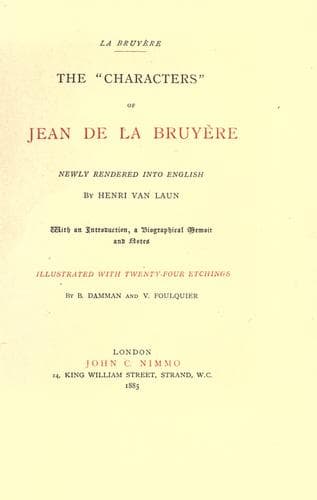
The "Characters" of Jean de La BruyèreLa Bruyère, Jean de
General
The "Characters" of Jean de La Bruyère
La Bruyère, Jean de
Character sketches -- Early works to 1800; Characters and characteristics
Deplorable is the condition of an innocent person whose trial has been
hurried, and who is found guilty. Can even that of his judge be more
lamentable?
(53.) If I had been told that in former ages a _prévôt_, or one of
those magistrates appointed for the apprehension and destruction of
rogues and thieves, had been long acquainted with all such rascals,
knew their names and faces as well as the number and quantity of their
robberies, and all particulars about them; and had so far penetrated
all their actions and was so completely initiated in all their horrible
mysteries that, to prevent the clamour some great man was about to
raise for the loss of a jewel, stolen from him in a crowd when coming
from some party, he knew how to restore it to him, and that Parliament
interfered and had this magistrate tried; I should class such an event
with many others in history, which in the course of time have become
incredible. How, then, can I believe, what may be inferred from recent,
well-known, and clearly proved facts, that such a pernicious connivance
exists even at the present time, is made a jest of, and is looked upon
as a matter of course?[788]
(54.) There exists a large number of men, imperious towards the weak,
firm and inflexible when solicited by commoners, without any regard for
the inferior classes, rigid and severe in trifles, who will not accept
the smallest present, nor be persuaded by their dearest friends and
nearest relatives, and who only are to be bribed by women.[789]
(55.) It is not absolutely impossible for a man who is in high favour
to lose his suit.
(56.) A person who is dying may expect his last will to be listened to
as if it was an oracle; every man puts his own construction on it and
explains it as he pleases, or rather, as it will suit his inclination
or his interest.
(57.) There are some men of whom we may truly say that death does not
so much determine their last will as that it deprives them of life
as well as of their irresolution and restlessness: a fit of anger
moves them to make a will, whilst they are living, but when the fit
is over it is torn to pieces and burnt. They have as many wills in
their strong box as there are almanacs on their table, for every year
is sure to produce a new one; a second will is annulled by a third,
which is rendered void by another better drawn up, again invalidated by
a fifth and holographic will. Yet if a person who has an interest in
suppressing this last will has neither an opportunity, nor a desire,
nor the means of doing so, he must stand by its clauses and conditions;
for what can more clearly prove the intentions of a man, however
changeable, than a last deed, under his own hand, made so lately that
he had no time to change his mind?
Public-domain text, read in full here on John Shaqi.
Reviews
Reviews
No reviews yet
Be the first to share your thoughts on this work.
Elsewhere in the archive
Join the Discussion
Join the discussion
Sign in to leave a comment or review.
Sign InorCreate an account