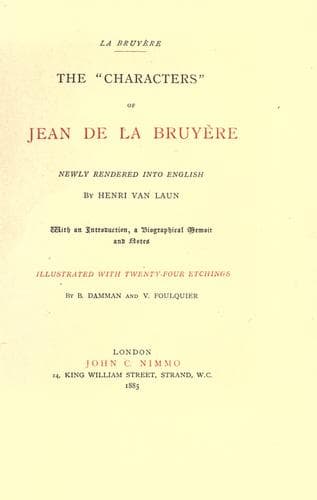
The "Characters" of Jean de La BruyèreLa Bruyère, Jean de
General
The "Characters" of Jean de La Bruyère
La Bruyère, Jean de
Character sketches -- Early works to 1800; Characters and characteristics
Whether our ancestors wrote better than we do, or whether we excel
them in our selection of words, style, and expression, perspicuity and
brevity, is a question often debated but never yet decided. But this
question is not at an end, if people will compare, as they sometimes
do, a dull writer of a past century to the most celebrated authors of
the present age, or the verses of Laurent,[827] who is paid for not
writing any more, to those of Marot and Desportes.[828] In order to
judge sensibly in this case we should compare one age to another, and
one first-rate piece of literary work to another, such as, for example,
the best _rondeaux_ of Benserade and Voiture[829] to the following two,
which tradition has handed down to us, but without transmitting to us
the name of the authors, or the time when they were written:[830]—
In timely sort Ogier came into Fraunce,
Of Paynim misbegot to rid the lond;
Needs not that I should tell his puissaunce,
Sit never foeman durst his glaunce withstond.
Thoʼ when he hath set all in happy chaunce,
Forth on a perlous jorney bent, he fond
In Paradise the well of youthʼs joyaunce,
Wherewith he thought to stay timeʼs threatening bond
In timely sort.
Thoʼ by this well his body, weak with years,
Upon a sodain changéd quight appears
To youthful wight, fresh, limber eke, and straight.
Great pitye ʼtis such lesinges tell no truth!
Virgins I wot of that bene past their youth,
To whom this bath had come, ere yet too late,
In timely sort.
* * * * *
Of this prow knight full many clerks have penned
That never daunger could his corage scare:
Whom natheless the foul fiend, which unaware
He ʼspoused in womanʼs shape, did foully shend.
So piteous case left his stout heart at end
Without one taint of fear or sordid care:
Whereof great praise throughout the world he bare—
If aught of credence we to tales may lend
Of this prow knight.
Eftsoones it chaunced the daughter of the king
Earned for his love, and made free offering
To Richard, of herself for second wife.
Then, if to keep a woman or a fiend
Be better, and which stirs more hellish strife,
He that would weet may question which was weened
Of this prow knight.
[Illustration]
XV.
OF THE PULPIT.[831]
(1.) A sermon at present has become a mere show, in which there is
not the least appearance of that evangelical gravity which is the
very soul of it; a good appearance, a well-modulated voice, careful
gestures, choice expressions, and prolonged enumerations supply its
place. To listen attentively whilst Holy Writ is dispensed is no longer
customary; going to church is an amusement, among numberless others,
and is a diversion in which there exists rivalry and many persons bet
on various competitors.
Public-domain text, read in full here on John Shaqi.
Reviews
Reviews
No reviews yet
Be the first to share your thoughts on this work.
Elsewhere in the archive
Join the Discussion
Join the discussion
Sign in to leave a comment or review.
Sign InorCreate an account