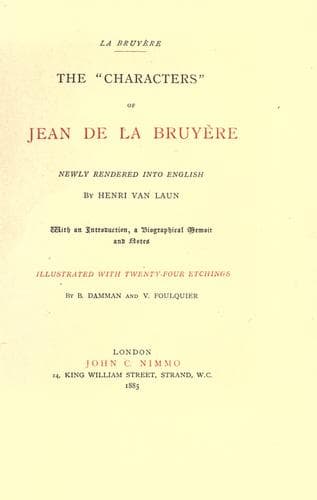
The "Characters" of Jean de La BruyèreLa Bruyère, Jean de
General
The "Characters" of Jean de La Bruyère
La Bruyère, Jean de
Character sketches -- Early works to 1800; Characters and characteristics
(2.) Profane eloquence is transferred from the bar, where Le Maître,
Pucelle, and Fourcroy[832] formerly practised it, and where it has
become obsolete,[833] to the Pulpit, where it is out of place.
Clergymen contest even the prize of eloquence at the altar and before
the holy mysteries; every person in the congregation thinks himself
a judge of the preacher, censures or applauds him, and is no more
converted by the sermon he approves of than by the one he condemns.
The orator pleases some and not others; but agrees with all in this:
that as he does not endeavour to render them better, they never trouble
their heads about becoming so.
An apprentice ought to be obedient and do what his master tells him; he
profits by his instructions, and in time becomes himself a master; but
man is more untoward, for he criticises the preacherʼs discourses as
well as the philosopherʼs works, and thus becomes neither a Christian
nor a philosopher.
(3.) Orators and declaimers will attract large congregations until
that man returns who in a style, based on the Holy Scriptures,
shall explain to the people the Word of God in a simple and familiar
manner.[834]
(4.) Quotations from profane authors, dull allusions, bathos,
antithesis, and hyperboles are no longer in vogue, and portraits[835]
will also cease to be in fashion, and give way to a plain exposition of
the gospel, accompanied by other means that produce conversion.
(5.) At length a man has made his appearance for whom I so impatiently
longed, but whom I dared not expect to behold in this age. The
courtiers, from delicacy of taste and a feeling of decorum, have
applauded him; and what is almost incredible, have left the kingʼs
chapel to mingle among the crowd, and hear the Word of God preached by
a truly apostolic man.[836] The town was not of the same opinion as the
court, and in whatever city-church he spoke not one of the parishioners
came, and the very churchwardens left their pew; the clergymen indeed
stuck to him, but the flock was scattered and went to swell the
congregations of neighbouring orators. This is what I should have
foreseen; and therefore, I ought not to have advanced that such a man,
whenever he appeared, would be universally followed, and would only
have to open his mouth to be listened to, for I know how difficult it
is to eradicate force of habit in mankind in all things. During the
past thirty years, rhetoricians, declaimers, and enumerators have been
listened to; and people run after preachers who depict in a grand style
or in miniature. Not long since sermons were full of points and clever
transitions, sometimes even so smart and pungent that they might have
served for epigrams: now, I confess, these are somewhat softened, and
may pass for madrigals. Three things, these preachers argue, are always
absolutely indispensable, mathematically necessary, and worthy of your
entire attention; one thing they prove in the first part of their
Public-domain text, read in full here on John Shaqi.
Reviews
Reviews
No reviews yet
Be the first to share your thoughts on this work.
Elsewhere in the archive
Join the Discussion
Join the discussion
Sign in to leave a comment or review.
Sign InorCreate an account