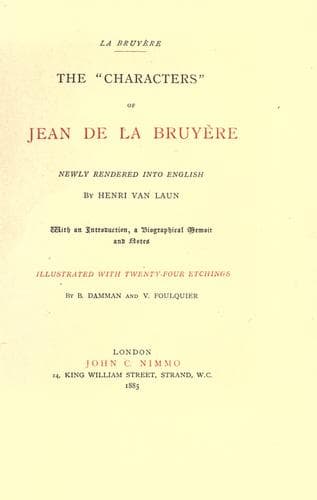
The "Characters" of Jean de La BruyèreLa Bruyère, Jean de
General
The "Characters" of Jean de La Bruyère
La Bruyère, Jean de
Character sketches -- Early works to 1800; Characters and characteristics
discourse, another in the second, and another in the third; so that
you are to be convinced of one truth, which is their first point of
doctrine; of another truth, which is their second point; and of a third
truth, which is their third point. In this manner the first reflection
will instruct you in one of the fundamental principles of religion;
the second in another principle which is not less fundamental; and
the last reflection in a third and last principle, the most important
of all, but which, for want of leisure, is reserved for another
opportunity. In a word, to recapitulate and abridge this division,
and to form a scheme of.... “Hold,” you exclaim, “do these preachers
require more preparation for a speech of not quite an hourʼs length
which they have to deliver? The more these gentlemen strive to explain
and make things clear to me, the more they bemuddle my brains.”—I can
well believe you, and it is the most natural result of such a mass and
confusion of ideas which come all to one and the same thing, but with
which they unmercifully burden the memory of their audience. To see
them obstinately persist in this custom, people would almost think
that the grace of being converted was inseparable of such long-winded
divisions and sub-divisions. But how is it possible to be converted by
apostles, whom we can hardly hear, follow, and keep in sight? I should
like to ask them to condescend and rest several times, in the midst of
their headlong career, and give their audience and themselves a short
breathing time. But I may spare myself the trouble of addressing them
and of wasting words on them. Homilies are out of date, and the Basils
and Chrysostoms[837] could not restore them, for if they came back,
people would take refuge in other dioceses, so as not to hear them nor
their familiar and instructive discourses. Men in general like fine
phrases and periods, admire what they do not understand,[838] fancy
themselves well informed, and are satisfied with deciding between a
first and second point of doctrine, or between the last sermon and the
last but one.
Public-domain text, read in full here on John Shaqi.
Reviews
Reviews
No reviews yet
Be the first to share your thoughts on this work.
Elsewhere in the archive
Join the Discussion
Join the discussion
Sign in to leave a comment or review.
Sign InorCreate an account