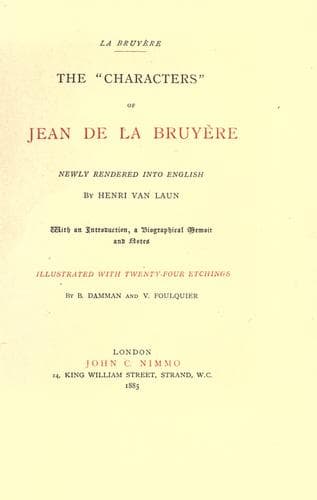
The "Characters" of Jean de La BruyèreLa Bruyère, Jean de
General
The "Characters" of Jean de La Bruyère
La Bruyère, Jean de
Character sketches -- Early works to 1800; Characters and characteristics
(6.) Not a hundred years ago a French book consisted of a certain
number of pages written in Latin, with here and there a line or two
of French scattered on each page. But such passages, anecdotes, and
quotations from Latin authors[839] did not only fill books; Ovid
and Catullus, at the bar, decided finally in cases of marriages and
wills, and were of as much use to widows and orphans as the Pandects
were.[840] Sacred and profane authors were inseparable, and seemed
to have slipped together in the pulpit; Saint Cyril and Horace, Saint
Cyprian and Lucretius, spoke by turns; the poets were of the same
opinion as Saint Augustin[841] and the rest of the Fathers. Latin was
the language spoken before women and churchwardens, for any length of
time, and even sometimes Greek; there was no preaching so wretchedly
without a prodigious amount of learning. But the times are changed, and
customs alter; the text still continues in Latin, but the sermons are
preached in French, and in the purest French, whilst the Gospel is not
so much as quoted. Little learning is requisite now-a-days to preach
very well.
(7.) Scholastic divinity is at last driven out of the pulpits of
all the great towns in the kingdom, and confined only to hamlets
and villages for the instruction and edification of ploughmen and
vine-dressers.
(8.) A preacher must have some intelligence to charm the people by
his florid style,[842] by his exhilarating system of morality, by the
repetition of his figures of speech, his brilliant remarks and vivid
descriptions; but, after all, he has not too much of it, for if he
possessed some of the right quality he would neglect these extraneous
ornaments, unworthy of the Gospel, and preach naturally, forcibly, and
like a Christian.
(9.) An orator paints some sins in such alluring colours, and
describes with such delicacy when they were committed, represents
the sinner as having so much wit, elegance, and refinement that, for
my part, if I feel no inclination to resemble his pictures, I have
at least occasion to betake myself to some teacher who, in a more
Christian style, may make me dislike those vices of which the other has
given such a seductive description.
(10.) A fine sermon is an oratorical speech, which, in all its rules
and freed from all its faults, is exactly governed by the same
principles as any other piece of human eloquence, and decked out with
all sorts of rhetorical ornaments. Not a passage nor a thought are lost
to connoisseurs; they easily follow the orator in all the digressions
in which he chooses to wander, as well as in his towering flights; he
is a riddle to none but to the common people.
Public-domain text, read in full here on John Shaqi.
Reviews
Reviews
No reviews yet
Be the first to share your thoughts on this work.
Elsewhere in the archive
Join the Discussion
Join the discussion
Sign in to leave a comment or review.
Sign InorCreate an account