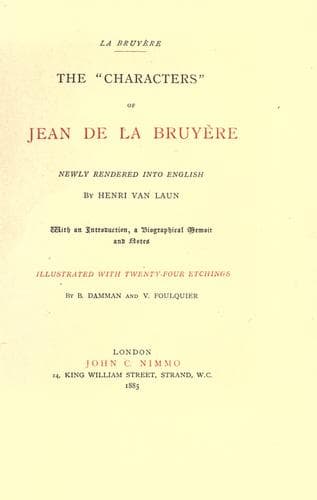
The "Characters" of Jean de La BruyèreLa Bruyère, Jean de
General
The "Characters" of Jean de La Bruyère
La Bruyère, Jean de
Character sketches -- Early works to 1800; Characters and characteristics
[152] The original has _de mise_, which was also used by Voltaire and
Rousseau, but seems now to have become antiquated.
[153] _Montre la corde_ in the original.
[154] When the “Characters” first made their appearance in 1689, Louis
XIV. no longer resided in the Louvre, but at Versailles. The greatest
nobles, in order to pay their court to the king, lodged in some
wretched rooms in the palace.
[155] The first part of this paragraph, referring to “false greatness,”
is said to apply to the Marshal de Villeroy; the second, alluding to
“true greatness,” to Marshal Turenne (1611-1675).
[156] An allusion to a fashion of the time La Bruyère wrote, when the
ladies wore shoes with very high heels and enormous head-dresses,
called _Fontanges_; the latter were invented by Marie-Angélique
Scoraille de Roussille, Duchesse de Fontanges (1661-1681), who was
one of the mistresses of Louis XIV. Our author refers to them in his
chapter “Of Fashion,” § 12.
[157] Some of the ladies at court, in order to hide the hollowness of
their cheeks, used, it is said, to hold small balls of wax in their
mouths.
[158] Lise is generally supposed to have been Catherine-Henriette
dʼAngennes de la Loupe, Countess dʼOlonne, one of the most dissolute
ladies of the court of Louis XIV., who was fifty-five years old when
this paragraph appeared (1692), and died in 1714. Many particulars
about her are related in Bussy-Rabutinʼs _Histoire amoureuse des
Gaules_.
[159] This is said to allude to a certain Mademoiselle de Loines, who
fell in love with a crooked, ill-looking, dwarfish limb of the law.
[160] The memoirs of the time of Louis XIV. teem with examples of young
men of the highest families who considered it no disgrace to live at
the expense of rich and amorous old crones, and even to receive money
from young ladies.
[161] The original has _dans une ruelle_. _Ruelle_ means literally “a
small street,” hence the narrow opening between the wall and the bed,
on which bed superfine ladies, gaily dressed, were lying when they
received their friends, and thus _ruelle_ came to mean “any fashionable
assembly.” In Dr. Ashʼs “Dictionary of the English Language,” London,
1755, _ruelle_ is still defined “a little street, a circle, an assembly
at a private house.”
[162] _En cravate et en habit gris_, says the French, which was the
usual dress of dandified magistrates, although they were strictly
forbidden to wear any other clothes but black ones.
[163] Only officers of the kingʼs household were allowed to wear
gold-embroidered scarfs.
[164] This alludes to the Count dʼAubigné, a brother of Madame de
Maintenon, who was no favourite at court. See also the portrait of
“Theodectes” in the chapter “Of Society and Conversation,” § 12, page
106.
[165] The “lady” is said to have been Madame de la Ferrière, the wife
of a _maître des requêtes_, and Dorinna a certain Mdlle. Foucault, a
relative of some well-known _conseiller au parlement_, who was in love
with a Doctor Moreau.
Public-domain text, read in full here on John Shaqi.
Reviews
Reviews
No reviews yet
Be the first to share your thoughts on this work.
Elsewhere in the archive
Join the Discussion
Join the discussion
Sign in to leave a comment or review.
Sign InorCreate an account