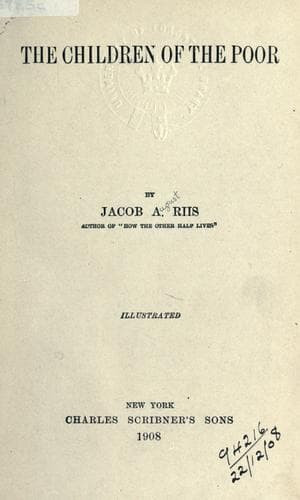
The Children of the PoorRiis, Jacob A. (Jacob August)
History
The Children of the Poor
Riis, Jacob A. (Jacob August)
Child welfare -- New York (State) -- New York; Poor; Poor -- New York (State) -- New York
Who and where are the slum children of New York to-day? That depends on
what is understood by the term. The moralist might seek them in Hell's
Kitchen, in Battle Row, and in the tenements, east and west, where the
descendants of the poorest Irish immigrants live. They are the ones, as I
have before tried to show, upon whom the tenement and the saloon set their
stamp soonest and deepest. The observer of physical facts merely would
doubtless pick out the Italian ragamuffins first, and from his standpoint
he would be right. Irish poverty is not picturesque in the New World,
whatever it may have been in the Old. Italian poverty is. The worst old
rookeries fall everywhere in this city to the share of the immigrants from
Southern Italy, who are content to occupy them, partly, perhaps, because
they are no worse than the hovels they left behind, but mainly because
they are tricked or bullied into putting up with them by their smarter
countrymen who turn their helplessness and ignorance to good account.
Wherever the invasion of some old home section by the tide of business has
left ramshackle tenements falling into hopeless decay, as in the old
"Africa," in the Bend, and in many other places in the down-town wards,
the Italian sweater landlord is ready with his offer of a lease to bridge
over the interregnum, a lease that takes no account of repairs or of the
improvements the owner sought to avoid. The crowds to make it profitable
to him are never wanting. The bait he holds out is a job at the ash-dump
with which he connects at the other end of the line. The house, the job,
and the man as he comes to them fit in well together, and the
copartnership has given the Italian a character which, I am satisfied from
close observation of him, he does not wholly deserve. At all events, his
wife does not. Dirty as _he_ seems and is in the old rags that harmonize
so well with his surroundings, there is that about her which suggests not
only the capacity for better things, but a willingness to be clean and to
look decent, if cause can be shown. It may be a bright kerchief, a bit of
old-fashioned jewelry, or the neatly smoothed and braided hair of the
wrinkled old hag who presides over the stale bread counter. Even in the
worst dens occupied by these people, provided that they had not occupied
them too long, I have found this trait crop out in the careful scrubbing
of some piece of oil-cloth rescued from the dump and laid as a mat in
front of the family bed; or in a bit of fringe on the sheet or quilt,
ragged and black with age though it was, that showed what a fruitful soil
proper training and decent housing would have found there.
Public-domain text, read in full here on John Shaqi.
Reviews
Reviews
No reviews yet
Be the first to share your thoughts on this work.
Join the Discussion
Join the discussion
Sign in to leave a comment or review.
Sign InorCreate an account