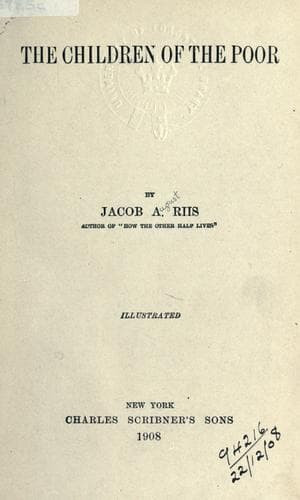
The Children of the PoorRiis, Jacob A. (Jacob August)
History
The Children of the Poor
Riis, Jacob A. (Jacob August)
Child welfare -- New York (State) -- New York; Poor; Poor -- New York (State) -- New York
In New York there is all the more reason because it is the open door
through which pours in a practically unrestricted immigration, unfamiliar
with and unattuned to our institutions; the dumping-ground where it rids
itself of its burden of helplessness and incapacity, leaving the
procession of the strong and the able free to move on. This sediment forms
the body of our poor, the contingent that lives, always from hand to
mouth, with no provision and no means of providing for the morrow. In the
first generation it pre-empts our slums;[1] in the second, its worst
elements, reinforced by the influences that prevail there, develop the
tough, who confronts society with the claim that the world owes him a
living and that he will collect it in his own way. His plan is a practical
application of the spirit of our free institutions as his opportunities
have enabled him to grasp it.
Thus it comes about that here in New York to seek the children of the poor
one must go among those who, if they did not themselves come over the sea,
can rarely count back another generation born on American soil. Not that
there is far to go. Any tenement district will furnish its own tribe, or
medley of many tribes. Nor is it by any means certain that the children
when found will own their alien descent. Indeed, as a preliminary to
gaining their confidence, to hint at such a thing would be a bad blunder.
The ragged Avenue B boy, whose father at his age had barely heard, in his
corner of the Fatherland, of America as a place where the streets were
paved with nuggets of gold and roast pigeons flew into mouths opening wide
with wonder, would, it is safe to bet, be as prompt to resent the
insinuation that he was a "Dutchman," as would the little "Mick" the
Teuton's sore taunt. Even the son of the immigrant Jew in his virtual
isolation strains impatiently at the fetters of race and faith, while the
Italian takes abuse philosophically only when in the minority and bides
his time until he too shall be able to prove his title by calling those
who came after him names. However, to quarrel with the one or the other on
that ground would be useless. It is the logic of the lad's evolution, the
way of patriotism in the slums. His sincerity need not be questioned.
Public-domain text, read in full here on John Shaqi.
Reviews
Reviews
No reviews yet
Be the first to share your thoughts on this work.
Join the Discussion
Join the discussion
Sign in to leave a comment or review.
Sign InorCreate an account