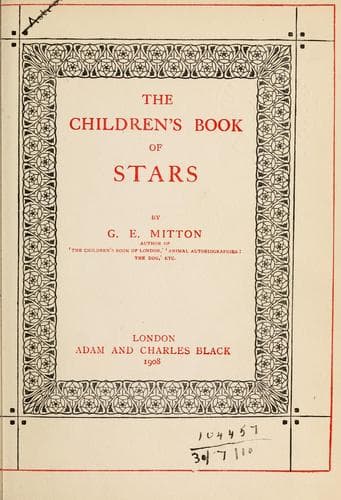
The Children's Book of StarsMitton, G. E. (Geraldine Edith)
Science
The Children's Book of Stars
Mitton, G. E. (Geraldine Edith)
Astronomy -- Juvenile literature
The sun has some influence on the tides too, and when moon and sun are
in the same line, as at full and new moon, then the tides are highest,
and are called spring tides; but when they pull in different directions,
as when it is half-moon, then the tides are lowest and are called neap
tides.
CHAPTER IV
THE EARTH'S BROTHERS AND SISTER
The earth is not the only world that, poised in space, swings around the
sun. It is one of a family called the Solar System, which means the
system controlled and governed by the sun. When we look up at the
glorious sky, star-studded night by night, it might seem to us that the
stars move only by reason of the earth's rotation; but when men first
began to study the heavens attentively--and this is so long ago that the
record of it is not to be found--they noticed that, while every shining
object in the sky was apparently moving round us, there were a few which
also had another movement, a proper motion of their own, like the moon.
These curious stars, which appeared to wander about among the other
stars, they called planets, or wanderers. And the reason, which was
presently discovered, of our being able to see these movements was that
these planets are very much nearer to us than any of the real stars,
and in fact form part of our own solar system, while the stars are at
immeasurable distances away. Of all the objects in the heavens the
planets are the most intensely interesting to us; for though removed
from us by millions of miles, the far-reaching telescope brings some of
them within such range that we can see their surfaces and discover their
movements in a way quite impossible with the stars. And here, if
anywhere, might we expect to find traces of other living beings like
ourselves; for, after all the earth is but a planet, not a very large
nor a very small one, and in no very striking position compared with the
other planets; and thus, arguing by what seems common-sense, we say, If
this one planet has living beings on its surface, may not the other
planets prove to be homes for living beings also? Counting our own
earth, there are eight of these worlds in our solar system, and also a
number of tiny planets, called asteroids; these likewise go round the
sun, but are very much smaller than any of the first eight, and stand in
a class by themselves, so that when the planets are mentioned it is
generally the eight large well-known planets which are referred to.
Public-domain text, read in full here on John Shaqi.
Reviews
Reviews
No reviews yet
Be the first to share your thoughts on this work.
Join the Discussion
Join the discussion
Sign in to leave a comment or review.
Sign InorCreate an account