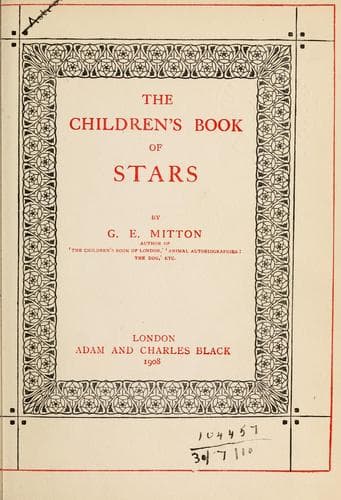
The Children's Book of StarsMitton, G. E. (Geraldine Edith)
Science
The Children's Book of Stars
Mitton, G. E. (Geraldine Edith)
Astronomy -- Juvenile literature
This is the solar system, and in it the only thing that shines by its
own light is the sun; all the rest, the planets and their moons, shine
only because the rays of light from the sun strike on their surfaces and
are reflected off again. Our earth shines like that, and from the nearer
planets must appear as a brilliant star. The little solar system is
separated by distances beyond the realm of thought from the rest of the
universe. Vast as are the intervals between ourselves and our planetary
neighbours, they are as nothing to the space that separates us from the
nearest of the steady shining fixed stars. Why, removed as far from us
as the stars, the sun himself would have sunk to a point of light; and
as for the planets, the largest of them, Jupiter, could not possibly be
seen. Thus, when we look at those stars across the great gulf of space,
we know that though we see them they cannot see us, and that to them our
sun must seem only a star; consequently we argue that perhaps these
stars themselves are suns with families of planets attached to them; and
though there are reasons for thinking that this is not the case with
all, it may be with some. Now if, after learning this, we look again at
the sky, we do so with very different eyes, for we realize that some of
these shining bodies are like ourselves in many things, and are shining
only with a light borrowed from the sun, while others are mighty glowing
suns themselves, shining by their own light, some greater and brighter,
some less than our sun. The next thing to do is to learn which are stars
and which are planets.
Of the planets you will soon learn to pick out one or two, and will
recognize them even if they do change their places--for instance, Venus
is at times very conspicuous, shining as an evening star in the west
soon after the sun goes down, or us a morning star before he gets up,
though you are not so likely to see her then; anyway, she is never found
very far from the sun. Jupiter is the only other planet that compares
with her in brilliancy, and he shines most beautifully. He is, of
course, much further away from us than Venus, but so much larger that he
rivals her in brightness. Saturn can be quite easily seen as a
conspicuous object, too, if you know where to look for him, and Mars is
sometimes very bright with a reddish glow. The others you would not be
able to distinguish.
It is to our earth's family of these eight large planets going steadily
round the same sun that we must give our attention first, before going
on to the distant stars. Many of the planets are accompanied by
satellites or moons, which circle round them. We may say that the sun is
our parent--father, mother, what you will--and that the planets are the
family of children, and that the moons are _their_ children. Our earth,
you see, has only one child, but that a very fine one, of which she may
well be proud.
Public-domain text, read in full here on John Shaqi.
Reviews
Reviews
No reviews yet
Be the first to share your thoughts on this work.
Join the Discussion
Join the discussion
Sign in to leave a comment or review.
Sign InorCreate an account