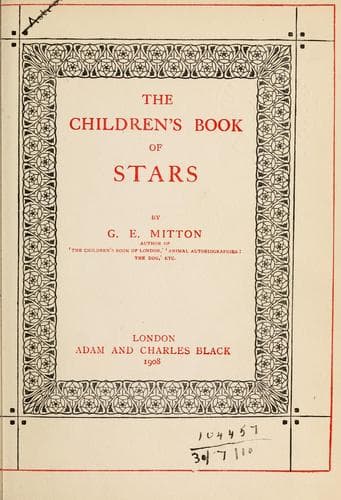
The Children's Book of StarsMitton, G. E. (Geraldine Edith)
Science
The Children's Book of Stars
Mitton, G. E. (Geraldine Edith)
Astronomy -- Juvenile literature
When we were talking of the earth and the moon we realized that once
long ago the moon must have been a part of the earth, at a time when the
earth was much larger and softer than she now is; to put it in the
correct way, we should say when she was less dense. There is no need to
explain the word 'dense,' for in its ordinary sense we use it every day,
but in an astronomical sense it does not mean exactly the same thing.
Everything is made up of minute particles or atoms, and when these
atoms are not very close together the body they compose is loose in
texture, while if they are closer together the body is firmer. For
instance, air is less dense than water, and water than earth, and earth
than steel. You see at once by this that the more density a thing has
the heavier it is; for as a body is attracted to another body by every
atom or particle in it, so if it has more particles it will be more
strongly attracted. Thus on the earth the denser things are really
heavier. But 'weight' is only a word we use in connection with the
earth; it means the earth's pulling power toward any particular thing at
the surface, and if we were right out in space away from the earth, the
pulling power of the earth would be less, and so the weight would be
less; and as it would be impossible always to state just how far away a
thing was from the earth, astronomers talk about density, which means
the number of particles a body contains in proportion to other bodies.
Thus the planet Jupiter is very much larger than the earth, but his
density is less. That does not mean to say that if Jupiter were in one
scale and the earth in the other he would weigh less, because he is so
very much bigger he would outweigh the earth still; his total _mass_
would be greater than that of the earth, but it means that a piece of
Jupiter the same size as a piece of the earth would weigh less under the
same conditions.
Now, before there were any planets at all or any sun, in the place of
our solar system was a vast gaseous cloud called a nebula, which slowly
rotated, and this rotation was the first impulse or force which God gave
it. It was not at all dense, and as it rotated a part broke off, and
inheriting the first impulse, went on rotating too. The impulse would
have sent it off in a straight line, but the pull of gravity from the
nebula held it in place, and it circled round; then the nebula, as it
rotated, contracted a little, and occupied less space and grew denser,
and presently a second piece was thrown off, to become in time another
planet. The same process was repeated with Saturn, and then with the
huge Jupiter. The nebula was always rotating and always contracting. And
as it behaved, so did the planets in their turn; they spun round and
cooled and contracted, and the moons were flung off from them, just as
they--the planets--had been flung off from the parent nebula.
Public-domain text, read in full here on John Shaqi.
Reviews
Reviews
No reviews yet
Be the first to share your thoughts on this work.
Join the Discussion
Join the discussion
Sign in to leave a comment or review.
Sign InorCreate an account