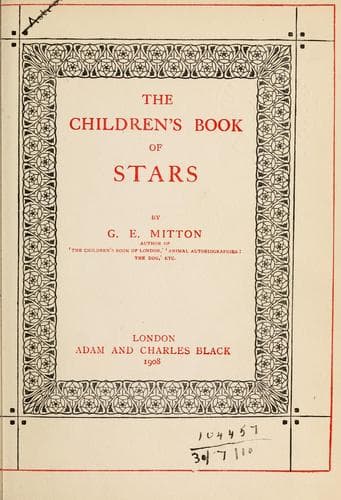
The Children's Book of StarsMitton, G. E. (Geraldine Edith)
Science
The Children's Book of Stars
Mitton, G. E. (Geraldine Edith)
Astronomy -- Juvenile literature
Now, after the original nebula had parted with the mighty mass of
Jupiter, it never again made an effort so great, and for a long time
the fragments that were detached were so small as hardly to be worth
calling planets; they were the asteroids, little lumps and fragments
that the nebula left behind. But as it still contracted in time there
came Mars; and having recovered a little, the nebula with more energy
got rid of the earth, and next Venus, and lastly little Mercury, the
smallest of the eight planets. Then it contracted further, and perhaps
you can guess what the remainder of it is--the sun; and by spinning in a
plastic state the sun, like the earth, has become a globe, round and
comparatively smooth; and its density is now too great to allow of its
losing any more fragments, so, as far as we can see, the solar system is
complete.
This theory of the origin of the planets is called the nebula theory. We
cannot prove it, but there are so many facts that can only be explained
by it, we have strong reason for believing that something of the kind
must have happened. When we come to speak of the starry heavens we shall
see that there are many masses of glowing gas which are nebulae of the
same sort, and which form an object-lesson in our own history.
We have spoken rather lightly of the nebula rotating and throwing off
planets; but we must not think of all this as having happened in a
short time. It is almost as impossible for the human mind to conceive
the ages required for such slow changes as to grasp the great gulfs of
space that separate us from the stars. We can only do it by comparison.
You know what a second is, and how the seconds race past without ceasing
day and night. It makes one giddy to picture the seconds there are in a
year; yet if each one of those seconds was a year in itself, what then?
That seems a stupendous time, but it is nothing compared with the time
needed to form a nebula into a planetary system. If we had five thousand
of such years, with every second in them a year, we should then only
have counted one billion real years, and billions must have passed since
the sun was a gaseous nebula filling the outermost bounds of our
system!
CHAPTER V
FOUR SMALL WORLDS
What must the sun appear to Mercury, who is so much nearer to him than
we are? To understand that we should have to imagine our sun increased
to eight or nine times his apparent size, and pouring out far greater
heat and light than anything that we have here, even in the tropics. It
was at first supposed that Mercury must have an extra thick covering of
clouds to protect him from this tremendous glare; but recent
observations tend to prove that, far from this, he is singularly free
from cloud. As this is so, no life as we know it could possibly exist on
Mercury.
Public-domain text, read in full here on John Shaqi.
Reviews
Reviews
No reviews yet
Be the first to share your thoughts on this work.
Join the Discussion
Join the discussion
Sign in to leave a comment or review.
Sign InorCreate an account