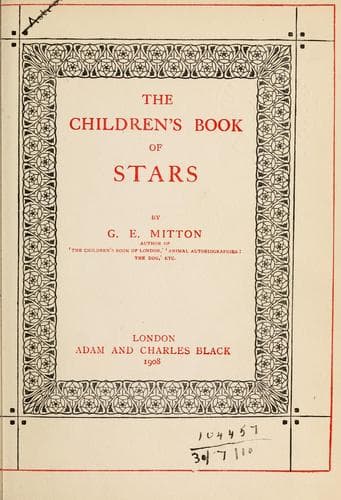
The Children's Book of StarsMitton, G. E. (Geraldine Edith)
Science
The Children's Book of Stars
Mitton, G. E. (Geraldine Edith)
Astronomy -- Juvenile literature
His year--the time he takes to go round the sun and come back to the
same place again--is eighty-eight days, or about one-quarter of ours. As
his orbit is much more like an ellipse than a circle, it follows that he
is much nearer to the sun at one time than at another--in fact, when he
is nearest, the size of the sun must seem three and a half times
greater than when he is furthest away from it! Even at the best Mercury
is very difficult to observe, and what we can learn about him is not
much; but, as we have heard, his axis is supposed to be upright. If so
his seasons cannot depend on the bend toward or away from the sun, but
must be influenced solely by the changes in his distance from the sun,
which are much greater than in our own ease. There is some reason to
believe, too, that Mercury's day and year are the same length. This
means that as the planet circles round the sun he turns once. If this is
so the sun will shine on one half of the planet, producing an
accumulated heat terrific to think of; while the other side is plunged
in blackness. The side which faces the sun must be heated to a pitch
inconceivable to us during the nearer half of the orbit--a pitch at
which every substance must be at boiling-point, and which no life as we
know it could possibly endure. Seen from our point of view, Mercury goes
through all the phases of the moon, as he shines by the reflected light
of the sun; but this point we shall consider more particularly in regard
to Venus, as Venus is nearer to us and easier to study. For a long time
astronomers had a fancy that there might be another planet even nearer
to the sun than Mercury, perhaps hidden from us by the great glare of
the sun. They even named this imaginary planet Vulcan, and some thought
they had seen it, but it is tolerably certain that Vulcan existed only
in imagination. Mercury is the nearest planet to the sun, and also the
smallest, of course excepting the asteroids. It is about three thousand
miles in diameter, and as our moon is two thousand miles, it is not so
much bigger than that. So far as we are concerned, it is improbable we
shall ever know very much more about this little planet.
But next we come to Venus, our beautiful bright neighbour, who
approaches nearer to us than any other heavenly body except the moon.
Alas! when she is nearest, she like Mercury, turns her dark side toward
us, coming in between us and the sun, so that we cannot observe her at
all.
Public-domain text, read in full here on John Shaqi.
Reviews
Reviews
No reviews yet
Be the first to share your thoughts on this work.
Join the Discussion
Join the discussion
Sign in to leave a comment or review.
Sign InorCreate an account