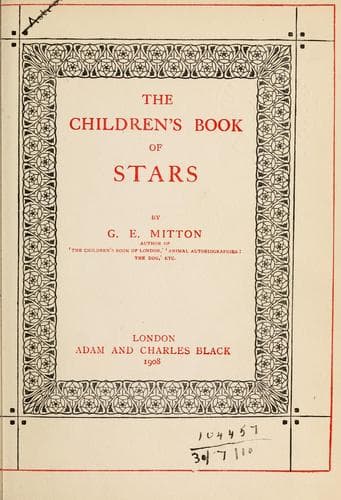
The Children's Book of StarsMitton, G. E. (Geraldine Edith)
Science
The Children's Book of Stars
Mitton, G. E. (Geraldine Edith)
Astronomy -- Juvenile literature
On a clear moonless night the stars appear uncountable. You see them
twinkling through the leafless trees, and covering all the sky from the
zenith, the highest point above your head, down to the horizon. It seems
as if someone had taken a gigantic pepper-pot and scattered them far and
wide so that some had fallen in all directions. If you were asked to
make a guess as to how many you can see at one time, no doubt you would
answer 'Millions!' But you would be quite wrong, for the number of stars
that can be seen at once without a telescope does not exceed two
thousand, and this, after the large figures we have been dealing with,
appears a mere trifle. With a telescope, even of small power, many more
are revealed, and every increase in the size of the telescope shows more
still; so that it might be supposed the universe is indeed illimitable,
and that we are only prevented from seeing beyond a certain point by our
limited resources. But in reality we know that this cannot be so. If
the whole sky were one mass of stars, as it must be if the number of
them were infinite, then, even though we could not distinguish the
separate items, we should see it bright with a pervading and diffused
light. As this is not so, we judge that the universe is not unending,
though, with all our inventions, we may never be able to probe to the
end of it. We need not, indeed, cry for infinity, for the distances of
the fixed stars from us are so immeasurable that to atoms like ourselves
they may well seem unlimited. Our solar system is set by itself, like a
little island in space, and far, far away on all sides are other great
light-giving suns resembling our own more or less, but dwindled to the
size of tiny stars, by reason of the great void of space lying between
us and them. Our sun is, indeed, just a star, and by no means large
compared with the average of the stars either. But, then, he is our own;
he is comparatively near to us, and so to us he appears magnificent and
unique. Judging from the solar system, we might expect to find that
these other great suns which we call stars have also planets circling
round them, looking to them for light and heat as we do to our sun.
There is no reason to doubt that in some instances the conjecture is
right, and that there may be other suns with attendant planets. It is
however a great mistake to suppose that because our particular family in
the solar system is built on certain lines, all the other families must
be made on the same pattern. Why, even in our own system we can see how
very much the planets differ from each other: there are no two the same
size; some have moons and some have not; Saturn's rings are quite
peculiar to himself, and Uranus and Neptune indulge in strange vagaries.
So why should we expect other systems to be less varied?
Public-domain text, read in full here on John Shaqi.
Reviews
Reviews
No reviews yet
Be the first to share your thoughts on this work.
Elsewhere in the archive
Join the Discussion
Join the discussion
Sign in to leave a comment or review.
Sign InorCreate an account