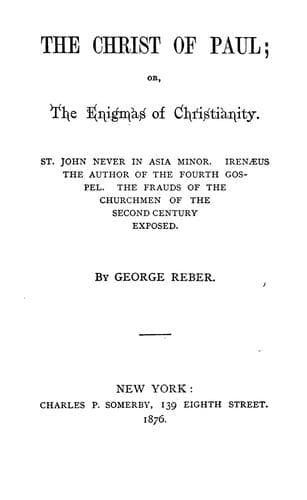
The Christ of Paul; Or, The Enigmas of ChristianityReber, George
Religion
The Christ of Paul; Or, The Enigmas of Christianity
Reber, George
Bible. New Testament -- Controversial literature; Church history -- Primitive and early church, ca. 30-600 -- Controversial literature
So strong was the proof in the last half of the second century that John
had never been to the western coast of the Mediterranean, that Irenæus
and others of that century dare not assert that the fourth Gospel
was written by him in Asia Minor. On this point the great criminal is
silent. But, in the Gospel itself, there is an evident effort made to
have it appear that it was written before the fall of Jerusalem. Even
the learned Basnage and Lampe were betrayed into this belief, and so
were others. Lardner fixes the date in the year 68, Owen 69, and the
learned Michaelis in 70. That such men should have fallen into this
belief is truly wonderful, for its fallacy is apparent at first view.
This Gospel, as none dispute, was written in reply to the Gnostics, and
as none of that sect, as will be shown, was known to be in existence
until the second century, it at once disposes of the question.
Chrysostom, Epiphanius, Mills, Fabricius and Bishop Tomline, with
others, saw the dilemma, and fixed the date of the Gospel at a later
period--some at 97, and others at 98.
That part of this Gospel by which Dr. Lardner and others were misled is
as follows: "_Now there is at Jerusalem_, by the sheep-market, a pool
which is called in the Hebrew tongue Bethesda, having five porches."
From the language here used, they conclude that Jerusalem was standing
when the Gospel was written, as the present is used instead of the past
tense. Few things troubled the Catholics of the second century more than
to find a convenient date for John's Gospel. If it was written before
the fall of Jerusalem, where there was a sheep market having five
porches still standing, it was too early, by many years, for Corinthus
and other leading Gnostics. If its date were fixed at the end of the
century when John was in Asia Minor, Catholics were met with proof that
John never was there. The story of the angel, and the man who had an
infirmity for eight-and-thirty years, was a clumsy invention to make way
for the deception as to the early date of the Gospel. If there was in
fact such a pool as represented, whose medical properties were dependent
upon the visitation of an angel, and which had properties to cure all
diseases, it was the only one of the kind, or anything like it, ever
known to man; its fame would have spread far and wide, and Jewish
historians, who delight to dwell upon anything which belongs to their
country, would have emphasized a phenomenon like the pool of Bethesda,
as proof of divine favor shown to their nation. It excites the anger of
commentators, and Doddridge among the rest, that Josephus has failed to
notice it; and among the extraordinary motives assigned for his
silence is a fear that he "_would disgust his pagan readers_"! The same
commentator says: "It is probable that the miracle was not wrought
for any length of time, and perhaps ceased on this occasion. This may
account for the surprising silence of Josephus in a story which made
Public-domain text, read in full here on John Shaqi.
Reviews
Reviews
No reviews yet
Be the first to share your thoughts on this work.
Elsewhere in the archive
Join the Discussion
Join the discussion
Sign in to leave a comment or review.
Sign InorCreate an account