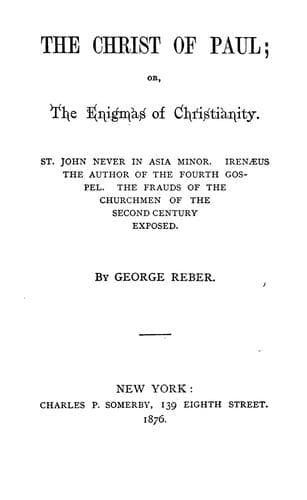
The Christ of Paul; Or, The Enigmas of ChristianityReber, George
Religion
The Christ of Paul; Or, The Enigmas of Christianity
Reber, George
Bible. New Testament -- Controversial literature; Church history -- Primitive and early church, ca. 30-600 -- Controversial literature
so much for the honor of his nation. He himself was not born when it
happened, and, though he might have heard the report of it, he would,
_perhaps (in the modern way), oppose speculation and hypothesis to
fact_." Jenks, another commentator, says: "It is true the Jewish
historians, who are not sparing in praise of Jerusalem, do none of them
mention this pool, for which, perhaps, this is the reason: that it was
taken as a presage of the approach of the Messiah, and, _therefore, they
who denied him to be come industriously concealed such an indication
of his coming_." No one has ever pretended to have found this pool,
although pious travelers have found every other spot consecrated by the
life and death of Christ. Helena, the mother of Constantine, as early
as A. D. 326, made a pilgrimage to the Holy City to discover the places
made sacred by scenes in the life of the Saviour; and when human
energy and skill failed, she called to her assistance the aid of the
miraculous. But the powers that enabled her to find the true cross,
after a waste in the earth of over three hundred years, and detect the
place of the Lord's sepulcher, and other sacred spots which Infidel
hatred vainly attempted to obliterate, failed to discover the place
where the angel of mercy found ground to rest her feet when she
descended from heaven, loaded with blessings for the blind, halt and
withered.
It is admitted by all writers, and especially Michaelis (vol. iii.
part I, p. 280), that the Gospel of John was written in answer to the
Gnostics, and especially Corinthus, who lived in the last years of the
first century. It was possible to spin out the life of John to the
end of the century, and thus bring him near the time when Corinthus
flourished; but it is fatal to the claim, set up by Irenaeus and others,
that John was the author of the fourth Gospel, that the quarrels which
grew out of the writings of Corinthus failed to attract notice until
some time about the middle of the second century. You may look in vain
among all the writings of the Fathers and others of the first century to
find the name of Corinthus or any of his writings, although we can trace
Gnosticism, in its primitive stages, as early as the first years in the
second. Still, it assumed but little importance in its contests with
Christianity until some time after the year A. D. 117. Buck says that
"_Many persons were infected with the Gnostic heresy in the first
century; though the sect did not render itself conspicuous, either for
numbers or reputation, before the reign of Adrian, when some writers
erroneously date its rise_? There was no call or demand for the fourth
Gospel until Christians and Gnostics commenced their quarrels, which was
long after John's death, even admitting that he lived to be a hundred
years old. There was no help in the emergency which then arose, but to
antedate the fourth Gospel, to confound the time when Cerinthus wrote
Public-domain text, read in full here on John Shaqi.
Reviews
Reviews
No reviews yet
Be the first to share your thoughts on this work.
Elsewhere in the archive
Join the Discussion
Join the discussion
Sign in to leave a comment or review.
Sign InorCreate an account