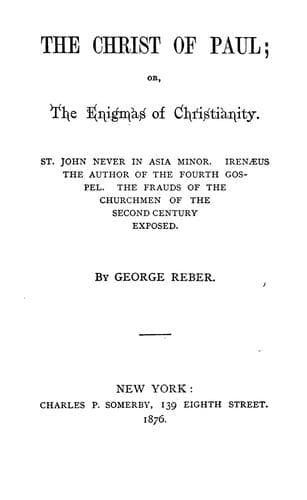
The Christ of Paul; Or, The Enigmas of ChristianityReber, George
Religion
The Christ of Paul; Or, The Enigmas of Christianity
Reber, George
Bible. New Testament -- Controversial literature; Church history -- Primitive and early church, ca. 30-600 -- Controversial literature
with the time when the spread of his doctrines created discussion among
Christians."
CHAPTER XXVII.
The phase assumed by Christianity in the fourth Gospel
demanded a new class of miracles from those given in the
first three.--A labored effort in this Gospel to sink the
humanity of Christ.--His address to Mary.--The temptation in
the wilderness ignored, and the last supper between him and
his disciples suppressed.--Interview between Christ and the
women and men of Samaria.--A labored effort to connect
Christ with Moses exposed.
When the incarnation became a leading feature of Christianity, its whole
spirit underwent a change from what it was in the first three Gospels.
The miracles which they describe are too tame for the new phase which
Christ is made to assume. None of the five, except one, in the Gospel
of John, are mentioned in the first three, for the apparent reason that
those in the Synoptics all fall short of upholding the claims set up
for Christ in the fourth. The subsidence of the sea at Tiberias, at his
command, was some proof that he held control of the wind and waves, but
a lucky coincidence might account for part, and ocular deception for the
rest. But, in that case, the constituents of the water were not changed.
Not so with the water at the feast at Cana. The restoration of the
widow's son at Nain, and of the daughter of Jairus, might admit of
doubt, for the first had not shown signs of decided death, and the
latter may have been a case of _coma_--"For the maid is not dead, but
sleepeth." (_Matt_. ix. 24.) But in the case of Lazarus there could be
no mistake. For four days the seal of death sat upon his brow, and flesh
and blood were fast returning to their native dust. Christ, in the first
three Gospels, heals diseases and cures the blind; but how much was
to be referred to his power as a god, and how much to the skill of a
_Thera-peutæ_, might invite discussion. But in the cases of the man who
had an infirmity for eight-and-thirty years, and the one born blind,
there could be no ground for dispute. The miracles selected proved all
that was claimed for Christ in the first part of the Gospel. He was
master of the elements, death heard and obeyed his voice, and he held
the avenues which led from fife to the grave. The miracle of the loaves
and fishes is the only one in the first three Gospels repeated by John,
because it proved his power over nature; for if he did not change the
elements, as he did at Cana, he multiplied them. We see in this Gospel
a studied effort to avoid anything like a human parentage for Christ, as
stated in the first three Gospels. The trip to Bethlehem, the birth in
the manger, the journey of the wise men from the East, are all omitted.
The name of Mary in this Gospel is studiously kept in the background.
She is barely mentioned twice, once at the feast of Cana: "And when
they wanted wine, the mother of Jesus saith unto him, They have no wine;
Public-domain text, read in full here on John Shaqi.
Reviews
Reviews
No reviews yet
Be the first to share your thoughts on this work.
Elsewhere in the archive
Join the Discussion
Join the discussion
Sign in to leave a comment or review.
Sign InorCreate an account