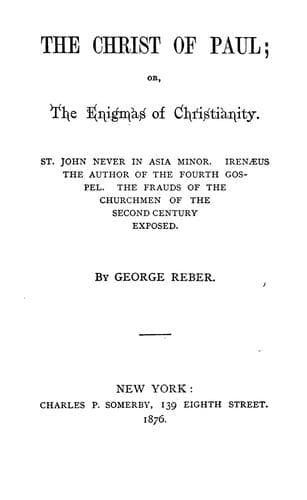
The Christ of Paul; Or, The Enigmas of ChristianityReber, George
Religion
The Christ of Paul; Or, The Enigmas of Christianity
Reber, George
Bible. New Testament -- Controversial literature; Church history -- Primitive and early church, ca. 30-600 -- Controversial literature
Jesus saith unto her, _Woman, what have I to do with thee?_" The true
answer intended by the question was--_nothing_. Christ could not be
entirely oblivious of earthly ties. He had lived under the same roof
with Mary. He had received from her many acts of kindness; and if nature
was allowed her empire over the heart; he must have felt for her the
affection of a son. For him she had all the feelings of a mother. She
followed and stood by him at the cross. As she stood and wept in his
sight, the only words of consolation and endearment he could give her
were as cold and heartless as a Lapland wind: "_Woman_, behold thy son"!
The word "_woman_" was ever on his lips. When he recommends her, at the
last scene, to the care of the disciples, he is studied and guarded in
his language: "Then saith he to the disciple, Behold _thy mother_." The
scenes at the cross were too solemn to permit the studied purpose of an
artful bigot to muzzle the voice of nature. Truth turns away from the
story.
The design of this Gospel to keep out of view the carnal nature of
Christ, as it appears in the first three Gospels, is marked with
Jesuitical cunning. He who was born, not of blood, nor of the will
of the flesh, but of God, must be so constituted as to be above the
weaknesses and frailties of those who are born of earth. The temptations
in the wilderness, which supply the most remarkable scenes in the life
of Christ, and, as given in the first three Gospels, proved the power of
the Son of God over the Powers of Darkness, are wholly unnoticed in the
Gospel of John. He who was all God, without a link to connect him
with humanity, must be so superior to Satan as to be above his arts
of seduction. John will not allow Christ to be tempted, because he was
above it; but, in sinking his humanity to favor a dogma, he keeps out of
sight the most sublime and god-like portion of his character--the power
to rise above the allurements of wealth, power, and dominion. It was by
such things he proved himself a god. The design of the fourth Gospel is
overdone. In making Christ all God, no chord of sympathy is left between
him and man. Even in the last supper, dwelt upon with so much tenderness
by Matthew, Mark and Luke, we detect, by the silence of John, the spirit
of the Jesuit. He makes no mention of it. Who can mistake the reason of
this silence? The tender scenes of this last interview between Christ
and his disciples are sacrificed to make way for a senseless and
heartless dogma. In the last supper, given in the Synoptics, the bread
and wine are mere symbols of the death and sufferings of Christ. It was
this symbolic character of the sacrament that the writer of John wished
to avoid. As the Lord's supper is with John a real sacrifice, each
repetition is a fresh atonement, and the bread and wine, by a miraculous
conversion, are made flesh and blood. There could be no sacrifice of
the body of Christ _until death_, and, for that reason, the last supper
Public-domain text, read in full here on John Shaqi.
Reviews
Reviews
No reviews yet
Be the first to share your thoughts on this work.
Elsewhere in the archive
Join the Discussion
Join the discussion
Sign in to leave a comment or review.
Sign InorCreate an account