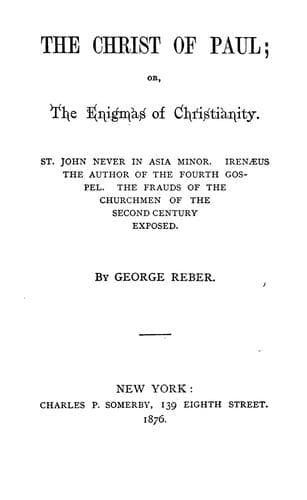
The Christ of Paul; Or, The Enigmas of ChristianityReber, George
Religion
The Christ of Paul; Or, The Enigmas of Christianity
Reber, George
Bible. New Testament -- Controversial literature; Church history -- Primitive and early church, ca. 30-600 -- Controversial literature
For nearly two thousand years, the Jews
have protested against an alliance, while, on the other side, Christians
have striven to maintain it. The two parties, in the meantime, were kept
separate by an ocean of blood which flowed between. No bridge could
ever span it--no bridge ever can. In conclusion of this branch of the
subject, we repeat, that great efforts are made to have it appear in
this Gospel that Christ is in harmony with Moses and the prophets,
whereas there is scarce a word in it which declares his equality with
the Father (and it teaches little else) not met with a denial from
Sinai, amid "thunders and lightnings" and "the voice of the trumpet":
"_Thou shalt have no other gods before me?_" Moses is sublime in threats
and denunciations against those who depart from the true and _only_ God.
The men of the second century knew nothing of the spirit of the Mosaic
faith, or they never would have stultified themselves by such a work as
the fourth Gospel.
CHAPTER XXVIII.
The first two chapters of Matthew not in existence during
the time of Paul and Apollos.--A compromise was made between
their followers at the council at Smyrna, A. D. 107.--The
creed of the Church as it existed at that day determined,
and how Christ was made manifest.--Catholics of the second
century repudiate this creed and abuse Paul.--Further proof
that Irenaeus never saw Polycarp.--Injuries inflicted upon
the world by the fourth Gospel.
We have shown in another place that not long after Apollos arrived at
Corinth he came in collision with Paul on some question which related
to Christ. Just what that difference was, it is hard in this age of the
world to determine; but it will be sufficient for our purpose at this
time to show what it was not. Had it been claimed by Apollos and his
followers that Christ was born in the way in which it is stated in
Matthew's Gospel, Paul, instead of wasting a whole lifetime in fighting
his enemies, would have gone straight to Jerusalem, and proved by
living witnesses that there was not a word of truth in this Gospel
which related to the supernatural birth of Christ. Paul's troubles with
Apollos and his school commenced as early as 57. At that time there were
thousands upon thousands who were born about the time Christ was, and
were comparatively young men when he was put to death. It was before the
fall of Jerusalem, and before any great calamity had befallen the Jewish
people. Many of the disciples may have been still living. Peter we know
was, for in 64 we find him preaching in Chaldea. Doubtless there
were still living, in Nazareth, women who grew up with Mary, and were
acquainted with her entire history. The Greeks did not contend, as long
as Paul lived, for anything stated in the first two chapters of Matthew
on the subject of the birth of Christ; for that reason there is no
mention of Mary by Paul in any of his epistles. What, then, was the
Public-domain text, read in full here on John Shaqi.
Reviews
Reviews
No reviews yet
Be the first to share your thoughts on this work.
Elsewhere in the archive
Join the Discussion
Join the discussion
Sign in to leave a comment or review.
Sign InorCreate an account