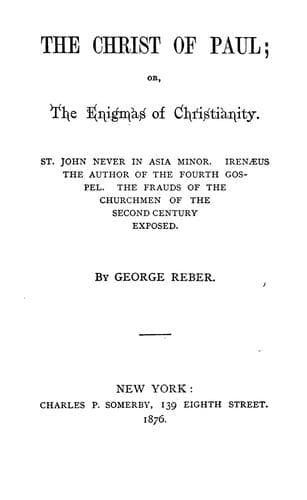
The Christ of Paul; Or, The Enigmas of ChristianityReber, George
Religion
The Christ of Paul; Or, The Enigmas of Christianity
Reber, George
Bible. New Testament -- Controversial literature; Church history -- Primitive and early church, ca. 30-600 -- Controversial literature
trouble? With Philo, the Logos was born in Heaven, and from thence he
descended to earth. With Paul, Christ was born on the earth, and in this
respect did not differ from other mortals. If the Logos was the Son of
God, and came down from heaven, by what instrumentalities did he reach
the earth? It was for Apollos to show how this was brought about.
Nothing is more difficult in the history of Christianity than to
find out what was Apollos belief as to the way by which the Logos is
connected or identified with the man Christ. The story of the descent of
the Spirit in the form of a dove, at the Jordan, was not known until a
long time after Paul's death. Paul could not disprove it, for during his
life no one asserted it. To establish this connection, we gather from
Paul that the school of Apollos had some subtle mode of reasoning, the
distillation of Greek wisdom and cunning. He never says what it was, but
compares it to the subtle sophistry with which the serpent deceived
Eve. To the wisdom of the Greeks Paul has nothing to oppose but direct
revelations from God. He sits in opposition to Hellenic sophistry, his
power and wisdom derived from above. When he talks to the Jews, before
they will believe what he tells them, they demand that a sign shall
be given unto them--something tangible to the senses. But the Greeks
required no proof of this kind. Conviction with them as to Christ was
wholly dependent upon some device, doubtless an outgrowth of Platonic
philosophy. From what is said hereafter, we can venture the belief that
with Apollos the Logos was made Christ simply by the providence of God.
How this providence was exerted to bring about this result, was a proper
subject to employ the cunning, the wisdom and sophistry of the Greek
school. After Paul's death, and after the fall of Jerusalem, the change
from the Logos from on high to the Christ of the earth, simply by the
providence of God and the theory of Apollos, was too indefinite, and the
reasoning of the Greeks too weak, to satisfy the minds of men. In the
second century, Christianity had worked west, and the Latin element
began to make itself felt in the Church, and we shall soon see the means
employed by Providence to bring the Logos into the world. We can readily
see why, in the disputes between Paul and the Greeks, as they stood in
his day, the name of Mary is nowhere mentioned. There was no necessity
for it. Ignatius, one of the oldest Fathers of the Church, was Bishop
of Antioch in the year 70. When Trajan set out on his expedition against
the Parthians, he stopped for a short time in this city. As he had
refused to sacrifice to the gods for the safety of the Emperor, and was
outspoken against the pagans, even in the royal presence, Ignatius was
condemned, and ordered to be sent to Rome to be devoured by the wild
beasts of the amphitheatre. This, as some say, was in A.D. 107; but some
writers, with greater plausibility, fix the time as late as 115. We will
Public-domain text, read in full here on John Shaqi.
Reviews
Reviews
No reviews yet
Be the first to share your thoughts on this work.
Elsewhere in the archive
Join the Discussion
Join the discussion
Sign in to leave a comment or review.
Sign InorCreate an account