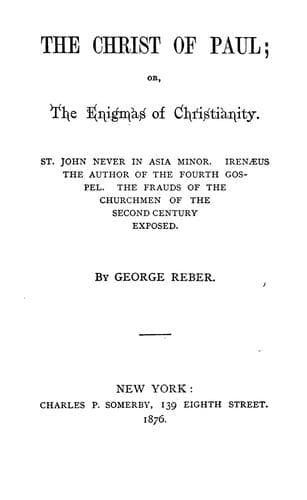
The Christ of Paul; Or, The Enigmas of ChristianityReber, George
Religion
The Christ of Paul; Or, The Enigmas of Christianity
Reber, George
Bible. New Testament -- Controversial literature; Church history -- Primitive and early church, ca. 30-600 -- Controversial literature
err on the right side, and adopt the former period. On his way to Rome
he stayed some time at Smyrna, where he wrote letters to the churches
in Asia, as a kind of legacy, in which he imparts to them a knowledge
of the doctrines of the Church, and the foundation on which they were
based. No man of his day was better informed on such subjects than
Ignatius, and the cruel fate that awaited him on his arrival in Rome
was an earnest that in what he said he was sincere. In his letter to the
Ephesians he tells how, in the first place, Christ came into the world.
_He was born in the womb of Mary according to the dispensation of
Providence, of the seed of David, yet by the Holy Ghost_. Here is a
platform to which Paul himself could hardly object. That that which
Ignatius declares to be the way in which Christ came into the world was
the doctrine of the Church in his day, and for some time after, cannot
be questioned. On his way to Rome he stopped at Smyrna, where Polycarp,
who was then Bishop at that place, lived, and it was there that Ignatius
wrote his letter to the Ephesians. Polycarp stood at his side when the
letter was written, and knew its contents, and probably took charge of
it, for he himself says: "The Epistles of Ignatius which he wrote unto
us and _others_, as many as we have with us, we have sent unto you
according to your order, which are subjoined to thy epistle, from which
ye may be greatly profited; for they treat of faith and patience, and
of all things which portend to edification in our Lord." (_Epistle to
Philippians_). On his way to Rome, Ignatius stopped at different places,
and everywhere the churches sent their bishops and other messengers to
visit and console the venerable Father on his way to the wild beasts;
and everywhere he taught Christ as we find it at this day in his letter
to the Ephesians. Here we have the doctrines or creed of the Church in
the beginning of the second century as to the status of Christ, as it
was declared by Polycarp, Ignatius, and all the churches of Asia. That
Paul, at this time, was held in great estimation is evident from what
Polycarp and others say of him in writing to the churches. Polycarp
alone refers to his epistles twenty-six times, and in speaking of him
says: "For neither can I, nor any other such as I am, come up to the
wisdom of the blessed and renowned Paul, who, being amongst you in
the presence of those who then lived, taught with _exactness_ and
_soundness_ the word of truth; who in his absence also wrote an epistle
to you, unto which, if you diligently look, you may be able to be
edified in the faith delivered unto you, which is the mother of us all."
(_Polycarp to the Philippians_, sec. 3). Indeed, Polycarp's letter to
the Philippians is made up of quotations from the letter of the great
apostle. The bitter feeling which existed between the followers of Paul
and Apollos had in a great measure died away at the close of the first
century.
Public-domain text, read in full here on John Shaqi.
Reviews
Reviews
No reviews yet
Be the first to share your thoughts on this work.
Elsewhere in the archive
Join the Discussion
Join the discussion
Sign in to leave a comment or review.
Sign InorCreate an account