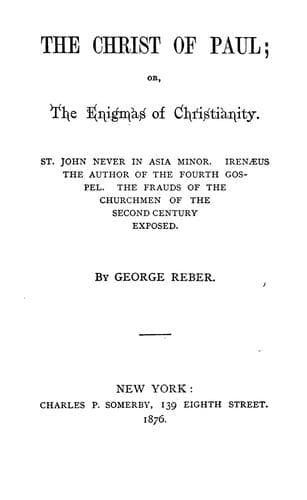
The Christ of Paul; Or, The Enigmas of ChristianityReber, George
Religion
The Christ of Paul; Or, The Enigmas of Christianity
Reber, George
Bible. New Testament -- Controversial literature; Church history -- Primitive and early church, ca. 30-600 -- Controversial literature
As a proof that the most learned scholars and correct thinkers, when
under the influence of an early bias, are liable to the most gross
mistakes and delusions, the following writers have given the authority
of their names to the belief, that Peter uses the name Babylon in a
figurative sense: Grotius, Macknight, Hale, Bishop Tomline, Whitby, and
Lardner. But a large majority of writers hold to the literal meaning.
Bishop Pearson, Le Clerk, and Mills think that Peter speaks of Babylon
in Egypt. Beza, Erasmus, Drusius, Dr. Cave, Lightfoot, Basnage,
Beausobre, Dr. Benson, A. Clarke think that Peter intended Babylon in
Assyria; Michaelis, that Babylon in Mesopotamia was meant. The frequent
use of the word Babylon in the Revelation attributed to St. John, which
there stands for Rome, is the principal argument used by those who
contend for a figurative sense. This book is the most impious and
malignant production among all the forgeries of the second century, and
its design can be readily exposed, if it was worth the time to do it.
Christ, whose last words were used in prayer for the forgiveness of his
enemies, is made through St. John to pour forth feelings full of hatred
against those who disagreed with the writer on matters of doctrine,
especially the followers of Paul. He hurls his envenomed shaft at the
heart of the great Apostle. It was at Ephesus where the war was warmest
between Paul's friends and the followers of the Alexandrian school. To
the church at that place, Christ is made to say: "I know thy works, and
thy labor, and thy patience, and _how thou canst not bear them which are
evil_: and thou hast tried them which say they are _Apostles, and are
not, and hast found them liars_." (_Revelation_ ii. 2.) Who could use
such language but a malignant partisan? Christ, the Son of God, is made
to use the language of a bar-room bully. When will those who profess to
be Christians, learn that Christ was all kindness, gentleness, and love.
They admit the authenticity and divine origin of writings that prove the
Son of God was not even a gentleman.
(C.)
Public-domain text, read in full here on John Shaqi.
Reviews
Reviews
No reviews yet
Be the first to share your thoughts on this work.
Elsewhere in the archive
Join the Discussion
Join the discussion
Sign in to leave a comment or review.
Sign InorCreate an account