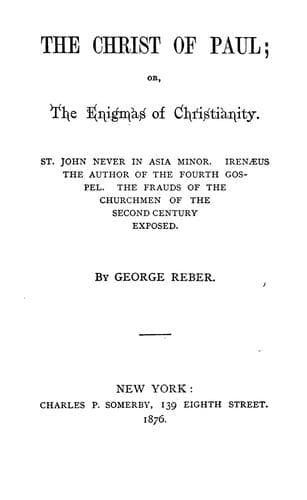
The Christ of Paul; Or, The Enigmas of ChristianityReber, George
Religion
The Christ of Paul; Or, The Enigmas of Christianity
Reber, George
Bible. New Testament -- Controversial literature; Church history -- Primitive and early church, ca. 30-600 -- Controversial literature
The writings ascribed to the Fathers, especially Polycarp and Ignatius,
are entitled to little consideration; for nothing is clearer than that
their names were used by the men of the second century to supply proof
when disputes sprang up, or give authority to doctrines when divisions
arose. The introduction to the epistle of Ignatius, addressed to the
church at Rome, is a bare-faced attempt to prove that there was a church
at Rome during the reign of Trajan, at the beginning of the second
century. It was written not only to prove that there was a church at
Rome at that time, but that it was the bank or depository of divine
riches, "_wholly filled with the grace of God, and entirely cleansed
from any other doctrine_." But we submit the whole passage to the
judgment of the reader. "Ignatius, who is also called Theophorus, to the
Church which hath obtained mercy in the majesty of the Most High Father,
and his only Son Jesus Christ, beloved and illuminated through the will
of him who willeth all things, which are according to the love of Jesus
Christ, our God; (to the church) which presides also in the place of the
region of the Romans, worthy of God, and of all honor and blessing and
praise; worthy to receive that which she wishes, chaste, and pre-eminent
in charity, bearing the name of Christ and of the Father, which I salute
in the name of Jesus Christ, the Son of the Father: to those who are
united both in flesh and spirit to all his commands, and wholly filled
with the grace of God, and entirely cleansed from the stain of any other
doctrine, be all undefiled joy in Jesus Christ our God."
The forger overdid the work in which he was engaged. This language,
addressed to a church illuminated with all things according to the
will of Christ and God, and worthy to receive all blessings and praise,
proves that the passage was written at a time when the dogma of the
Apostolic succession was in vogue, and Rome was putting forth claims to
spiritual supremacy.* No time was more unpropitious to prove that there
was _such a church_ at Rome, than that Goog embraced in the reign of
Trajan, when Christianity was a crime, which subjected the believer to
the penalty of death. There being no Christians in Rome from the death
of Paul to the time of Hadrian, it leaves the time to be taken up by
traditions, which was gladly seized upon by Irenaeus, who populated it
with Bishops and others, the offspring of his own imagination.
Public-domain text, read in full here on John Shaqi.
Reviews
Reviews
No reviews yet
Be the first to share your thoughts on this work.
Elsewhere in the archive
Join the Discussion
Join the discussion
Sign in to leave a comment or review.
Sign InorCreate an account