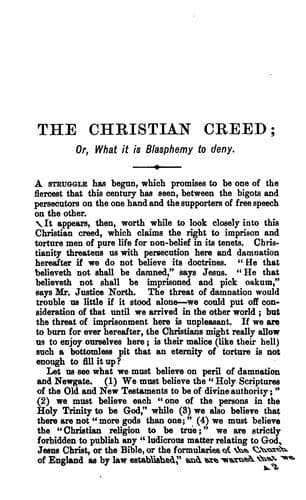
The Christian Creed; or, What it is Blasphemy to DenyBesant, Annie
Religion
The Christian Creed; or, What it is Blasphemy to Deny
Besant, Annie
Christianity -- Controversial literature
Sarai, about whose age there is some doubt, in consequence of the great
length of her husband’s years, was a very fair woman; reckoning by
Terah’s age, she must have been at this time at least 160 years old
(supposing that she married at 15), but she seems to have been only 90
years of age at least 25 years later (Gen. xvii., 17). However, whether
she was a fair woman of 160 summers, or a gay young thing of only 65,
she proved to be indeed a treasure to her husband. For it is of divine
authority that faithful Abraham pretended that his wife was only his
sister, and allowed King Pharaoh to take her and to pay him for her
“sheep, and oxen, and he-asses, and menservants, and maidservants, and
she-asses, and camels” (Gen. xii., 16); it is blasphemy to deny that god
plagued poor innocent “Pharaoh and his house with great plagues” because
they were deceived by his friend’s shameless venality and lying, and
that when Pharaoh discovered the fraud, Abram took himself off with his
wife and all he had gained by her sale, being, as the sacred narrative
naively remarks, “very rich” (Gen. xiii., 2) after this transaction.
It is blasphemy to deny that “he [god] is faithful that promised” (Heb.
x., 23); it is also blasphemy to deny that he [god] broke his promises.
For he promised Abram, over and over again, that he would give to him as
well as to his seed the land of Canaan (Gen. xiii., 15; xv., 7, 8;
xvii., 8, etc.); yet we find that Abram was obliged to buy a sepulchre
for his wife’s corpse, and never inherited the land at all. Even as far
as his seed was concerned, god broke the “everlasting covenant” (Gen.
xvii., 9) he made, to give to “thee and to thy seed after thee, the land
wherein thou art a stranger, even the land of Canaan for an everlasting
possession” (Gen. v., 8), for the Jews only possessed part of this land
for a short time, instead of for ever, and as defined by god, “this
land, from the river of Egypt unto the great river, the river Euphrates”
(Gen. xv., 18), they never had it at all. It is comforting to notice
that this promise-breaking god is the same who in the person of his son
declared: “he that believeth not shall be damned for as he did not keep
his word in the one case perhaps he will not do so in the other.
Public-domain text, read in full here on John Shaqi.
Reviews
Reviews
No reviews yet
Be the first to share your thoughts on this work.
Join the Discussion
Join the discussion
Sign in to leave a comment or review.
Sign InorCreate an account