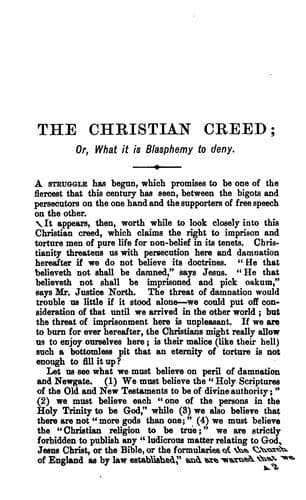
The Christian Creed; or, What it is Blasphemy to DenyBesant, Annie
Religion
The Christian Creed; or, What it is Blasphemy to Deny
Besant, Annie
Christianity -- Controversial literature
One day, as Abram was returning from the slaughter of some of his
enemies, a certain Melchizedek, named with charming appropriateness King
of Peace (Heb. vii., 2), went out to meet him, and blessed him. Nothing
is said in Genesis to make us regard Melchizedek as the extraordinary
being that he really was; for it is blasphemy to say that Melchizedek
was ever born, that he had any ancestors, that he ever died (Heb. vii.,
3); like Topsy, “’spects he growed”; where he is now nobody knows; he
would be a most useful “Christian antiquity,” but he is not producible.
On the world’s stage he made but this one appearance, “positively for
the first and last time.” Melchizedek is a type of Jesus Christ. Jesus
was born; Melchizedek was not. Jesus had a mother; Melchizedek had none.
Jesus had his descent from David; Melchizedek was without descent. Jesus
died; Melchizedek had no end of life. The correspondence between them is
really striking. The only similarity is that they were both without any
acknowledged father, and this peculiarity they share with many pagan
heroes and with some less important folk.
It is blasphemy to deny that Abram, the “friend of God,” took to himself
his wife’s maid, Hagar, and that when this poor slave was about to bear
him a child he chivalrously handed her over to her jealous mistress,
Sarai, saying: “Behold, thy maid is in her hand; do to her as it
pleaseth thee” (Gen xvi., 6). An ordinary man, under such circumstances,
would have had some tender, pitiful feeling towards the mother of his
unborn child; but Abram was a saint of God, and was above all weak
sentiment of that kind, so he stood quietly by while Sarai ill-treated
the woman who had lain in his arms, and let her flee away into the
wilderness unhelped and unpitied. God’s angel drove poor Hagar back to
her bondage, and after her return her son was born. At this time Abram
was 86 years of age; fourteen years later Sarah had a son, Isaac, and
some time after she insisted on turning out poor Ishmael, with his
mother, Hagar. A sweet, womanly creature was Sarah. Abraham made no
objection, but “rose up early in the morning” to send off his first-born
son and his mother, and was generous enough to take “bread and a bottle
of water,” and to make this splendid present to Hagar “putting it on her
shoulder, and the child, and sent her away.” “The child” was now about
fifteen years of age, and would have been a little heavy for poor Hagar
to carry if he had been an ordinary well-grown boy; he was, however,
curiously small for his age, for we learn that when “the water was spent
in the bottle” “she cast the child under one of the shrubs” (Gen. xxi.,
15). It is blasphemy to deny that Hagar carried this big baby, and threw
him about like a toy.
Public-domain text, read in full here on John Shaqi.
Reviews
Reviews
No reviews yet
Be the first to share your thoughts on this work.
Join the Discussion
Join the discussion
Sign in to leave a comment or review.
Sign InorCreate an account