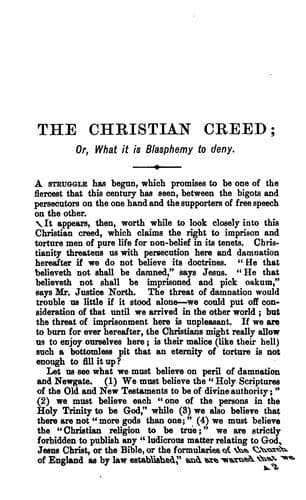
The Christian Creed; or, What it is Blasphemy to DenyBesant, Annie
Religion
The Christian Creed; or, What it is Blasphemy to Deny
Besant, Annie
Christianity -- Controversial literature
It is blasphemy to deny that god cursed the serpent— who had
unfortunately lost the power of speech just at the time at which he most
required it—for being the helpless tool of Satan, and condemned him to
go on his belly and to eat dust. Divine authority does not say how
snakes went about before this literal fall, whether on their heads or
their tails, so that the method of their locomotion is not of faith.
It is blasphemy to deny that god made coats of skins for Adam and Eve,
although coat-making seems rather a curious employment for a deity, and
scarcely as dignified as world-making. We are not told what became of
the animals whom god deprived of their skins for this purpose; nor
whether he killed them first. If he did, then death first entered into
the world by god’s immediate act. As it is blasphemy to deny that death
entered into the world by sin (Rom. v., 12), it is difficult to avoid
identifying god with sin, and this, again, is, I fear me, blasphemy.
If in any other old eastern book we read about trees the eating of the
fruit of which gave knowledge, serpents which talked, gods who walked in
gardens and who made coats, we should at once understand that we were
reading old myths, and should never dream of regarding them as a record
of historical facts. If we apply the same reasoning to the Bible,
Justice North will send us to pick oakum here, and we shall be burned
for ever hereafter.
It is blasphemy not to believe that “Cain went out from the presence of
the Lord” (Gen. iv., 16)—whom it is blasphemy to deny is everywhere
present—and that god put a mark on him lest any one—there being only in
existence his own family—“finding him should kill him” (Gen. iv., 15).
It is blasphemy not to believe that having a wife, who was also his
sister, and who bare him a son, he “builded a city” (Gen. iv., 17) for
himself, his wife and child. How many houses there were in the city, and
whether each of the three inhabitants lived in a separate house, or the
trio moved from house to house, so as to inhabit “the city,” these
things are not revealed by divine authority.
It is blasphemy not to believe that Adam lived 930 years, Cain 910
years, Methuselah 969 years; and that the rest of the antediluvian
patriarchs lived to approximate ages. It is useless to allege that such
preposterous terms of life are contrary to all experience. “He that
believeth not shall be damned.”
Public-domain text, read in full here on John Shaqi.
Reviews
Reviews
No reviews yet
Be the first to share your thoughts on this work.
Join the Discussion
Join the discussion
Sign in to leave a comment or review.
Sign InorCreate an account