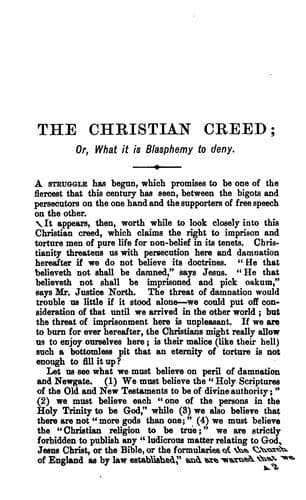
The Christian Creed; or, What it is Blasphemy to DenyBesant, Annie
Religion
The Christian Creed; or, What it is Blasphemy to Deny
Besant, Annie
Christianity -- Controversial literature
It is blasphemy to deny that man was created with woman, in the likeness
of god (Gen. i., 27, and v., 1,2), and came into a world replete with
life, with fowl and every living thing, over which god gave him dominion
(Gen. i., 28). It is also blasphemy to deny that man was created without
woman, and came into a world where there was no life, and that god,
pitying his loneliness, formed all living things in the attempt to make
a help meet for the man, and that failing in this attempt he lastly made
a woman, not with man but long afterwards (the making and naming of all
animals and birds intervening), out of one of the man’s ribs which he
detached for that purpose from his skeleton while the man was asleep
(Gen. ii., 7, 18, 19—22).
It is blasphemy to deny that god gave man for food “every tree in the
which is the fruit of a tree” (Gen. i., 29), while it is equally
blasphemy to deny that the “Lord God” withheld from him as food one of
the trees (Gen. ii., 17.)
It is blasphemy to deny that god, who is “the truth,” said that Adam
should die “in the day that” he eat the fruit of the tree of knowledge
(Gen. ii., 7), and it is blasphemy to deny that so far from dying in
that day, “all the days that Adam lived were 930 years,” and that “he
begat sons and daughters” (Gen. iv., 5, 4) long after the day on which,
unless we blaspheme and make god a liar (1 John v., 10), we must believe
that he died.
It is blasphemy to deny the fable of the Fall. It is of divine authority
that a talking snake persuaded Eve to eat the fruit of the forbidden
tree, and that by eating this fruit man and woman found out that they
were naked, a sufficiently obvious fact of which they appear to have
been ignorant. The first result of eating the forbidden fruit was a
regard for decency, and they made some somewhat inadequate clothes out
of fig leaves, sewing them together. There is no divine authority as to
the implements used, nor as to the discovery of the needles and thread
which seem necessary for the sewing. God who is “a spirit” (John iv.,
24) and who is “without body” and “parts” (1 Art of the Church
established by law) “walked in the garden” (Gen. iii., 8) soon
afterwards; it is blasphemy to deny that god walked, and blasphemy to
assert that he has legs. The method of walking without legs is not
revealed to us on divine authority, so we must believe (literally)
without understanding.
It is blasphemy to deny that “the eyes of the Lord are in every place;”
it is also blasphemy to assert that the eyes of the Lord were in the
special place wherein Adam and his wife “hid themselves from the
presence of the Lord God amongst the trees” (Gen. iii., 8). The only way
to reconcile these contradictions is to believe that Adam and his wife
and the trees behind which they hid themselves were nowhere, and to
believe this comes perilously near the blasphemy of denying the whole
story.
Public-domain text, read in full here on John Shaqi.
Reviews
Reviews
No reviews yet
Be the first to share your thoughts on this work.
Join the Discussion
Join the discussion
Sign in to leave a comment or review.
Sign InorCreate an account