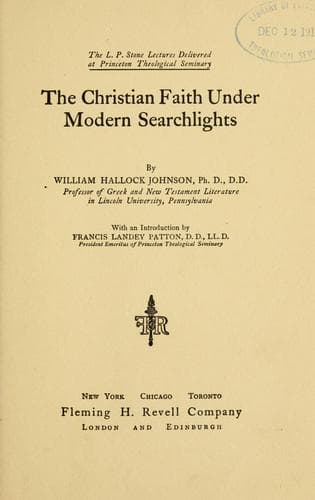
The Christian Faith Under Modern SearchlightsJohnson, William Hallock
Religion
The Christian Faith Under Modern Searchlights
Johnson, William Hallock
Modernism (Christian theology)
266: "Beiträge zur Einl. in das N. T.": I. "Lukas der Arzt," 1906;
II. "Sprüche und Reden Jesu," 1907; III. "Die Apostelgeschichte,"
1908; IV. "Neue Untersuchungen zur Apostelgeschichte und zur
Abfassungszeit des Synoptischen Evangelien," 1911. For convenience
these will be alluded to as I, II, III, and IV, in connection with
the English translation.
267: IV, p. 35; "Date of the Acts and of the Synoptic Gospels," p. 49.
268: _Ibid._, p. 62; E. T., p. 88.
269: "The Gospels as Historical Documents," Pt. II, 1909, p. 242.
In his "Date of the Acts and of the Synoptic Gospels" (IV), Harnack
reverses his former opinion and strongly defends a date for the Acts
within the lifetime of Paul and before the end of his trial at Rome.
Reviewing his former arguments for a later date, he finds them
inconclusive, and thinks that the earlier date is required by the abrupt
close of the Acts. Minor considerations favouring an early date are (1)
the titles for Christ in the early chapters, and for Christians, and the
description of the Jews as "the people of God"; (2) the fact that the
Jews are the persecutors and not the persecuted; (3) the absence of any
indication of the use of Paul's letters such as would be expected in a
later writer; (4) the use of the "first day of the week," instead of the
"Lord's Day," and of the names of Jewish feasts, in which Luke stands
with Paul against later writers. And (5) even the prediction, Acts xx.
25, which looks primarily to Jerusalem, not Rome, would not have been
written, if the second imprisonment be accepted, after its apparent
falsification by I Timothy i. 3 and 2 Timothy i. 18. H. Koch develops
these arguments independently,[270] and it can no longer be said that the
early dating of the Acts is "a pre-critical theory which rests on
sentimental or subjective grounds."[271]
270: "Die Abfassungszeit des lukanischen Geschichtswerkes," 1911.
271: J. Moffatt: "Historical New Testament," p. 414, note 4. It is
noticeable that Moffatt now favours the Lukan authorship, "put
practically beyond doubt by the exhaustive researches of Hawkins and
Harnack" ("Introduction to New Testament," p. 295), while advocating
a date later than Josephus' "Antiquities" (pp. 29 f.).
Why should the author follow so carefully the fortunes of the Apostle on
his voyage to Rome, and describe so fully the initial stages of his
trial, and yet leave the reader in doubt concerning its outcome?
Commentators have been puzzled by the seemingly inordinate space which
Luke devotes to the details of the voyage and shipwreck. Sometimes it is
said that the voyage marks the final rejection of the Jewish people; or
in the description is seen a literary device intended to intensify the
suspense of the reader; or allegorical interpretations are resorted to
by those who think that Luke would not thus descend from the level of
the philosophical historian to that of the novelist.
Public-domain text, read in full here on John Shaqi.
Reviews
Reviews
No reviews yet
Be the first to share your thoughts on this work.
Elsewhere in the archive
Join the Discussion
Join the discussion
Sign in to leave a comment or review.
Sign InorCreate an account