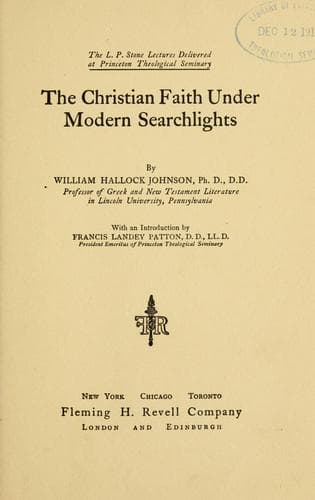
The Christian Faith Under Modern SearchlightsJohnson, William Hallock
Religion
The Christian Faith Under Modern Searchlights
Johnson, William Hallock
Modernism (Christian theology)
In the minute description of the voyage and shipwreck, Koch sees
evidence that the writer's experiences as Paul's companion on the
voyage were still fresh in his mind. The details would scarcely have
been remembered and recorded so vividly after twenty-five years. Even if
a journal had been kept, it is still strange that the minutiæ of the
story should have been retained in the perspective of the finished
history. "The author still stands under the fresh impression of the
wonderful divine guidance through which Paul, in spite of all dangers
and hindrances, reached his long sought goal." "What interest would a
reader of later times have in details such as that on an Alexandrian
ship precisely two hundred and seventy-six men were found?" In the
seventh or eighth decade more important contemporary events would have
stood in the foreground of interest.[272] A striking parallelism has been
observed between the Third Gospel and the Acts, while, supposing Paul's
death to have occurred, it is urged that Luke has missed "the
finest--the most essential--point of the whole comparison, the death of
Paul."[273]
272: H. Koch: "Die Abfassungszeit des lukanischen Geschichtswerkes,"
pp. 61, 62.
273: D. Walker: "The Gift of Tongues," p. 228.
The assumed intention of the author to write a third treatise does not
help the matter much. It is absurd, Ramsay admits, to relate the earlier
stages of the trial at great length, "and wholly omit the final result
which gives them intelligibility and purpose"; but his conclusion is
that "it therefore follows that a sequel was contemplated by the
author," a sequel which the "first" (prôtos) of Acts i. 1 implies, if
Luke "wrote as correct Greek as Paul wrote."[274] But the intention of
writing a sequel does not explain the failure to mention the outcome of
the trial. Luke would have no motive like the writer of a continued
story for keeping the reader in suspense, and the simple addition of the
words "until his release or acquittal" would have relieved the suspense,
and given "intelligibility and purpose" to the detailed description of
the earlier stages of the trial. The account of the Ascension is not
omitted from Luke's Gospel although given in greater detail in the Acts.
There is nothing un-philosophical in the abrupt ending of a history
which brings the record down to the date of writing.
274: "Paul the Traveller," pp. 307-309. The use of "first" (πρῶτos
[prôtos]) is not decisive, for it is used where there are but two
objects in the comparison in Acts xii. 10 (and see vii. 12), Hebrews
ix. 8 and 15, Apoc. xx. 5, and even I Corinthians xv. 47.
Public-domain text, read in full here on John Shaqi.
Reviews
Reviews
No reviews yet
Be the first to share your thoughts on this work.
Elsewhere in the archive
Join the Discussion
Join the discussion
Sign in to leave a comment or review.
Sign InorCreate an account