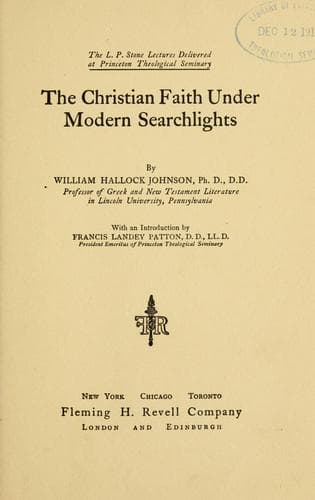
The Christian Faith Under Modern SearchlightsJohnson, William Hallock
Religion
The Christian Faith Under Modern Searchlights
Johnson, William Hallock
Modernism (Christian theology)
The argument from vocabulary is relied upon by Reitzenstein to prove the
influence of heathen ideas upon the thought of the Apostle. It is his
theory that Paul spent the two years of inner disturbance, in part at
least, in the study of Hellenistic religion and philosophy, and that
this influence helped him in the construction of a new religion. In
substance Reitzenstein's argument is that Paul shows the use of
technical religious terms found in the Hermetic writings, especially in
the "Poimandres"; and that the "Poimandres" is to be dated earlier than
the "Shepherd" of Hermas; and that the conceptions it embodies were
current in the Roman Empire, and in a literary form, in the time of
Paul. The argument is twofold, first, that the Hermetic writings were
current in the time of Paul, and, second, that Paul shows their
influence in his vocabulary. As the date of the "Poimandres," the most
important of the Hermetic writings, is in dispute, the latter point may
be considered first.
In the Pauline vocabulary Reitzenstein believes that we have "an
absolutely certain proof of the immediate influence of Hellenism upon
the Apostle, and at the same time a measure of its strength."[244] "Only
when the existence and meaning of a religious literature in Hellenism is
assured and the sort of linguistic dependence is seen to depend on
literary mediation is the opportunity of an explanation afforded."[245]
Many words thought to be characteristically Pauline are said to have
been technical terms in the popular mystery cults of the day, before the
Apostle adopted them as the expression of his own religious teaching.
244: "Die Hellenistische Mysterienreligionen," p. 58. (Afterward
referred to for convenience as "H. M. R.")
245: "H. M. R.," p. 209.
Without attempting to follow the argument in detail, we may observe
(_a_) that Paul uses many of these terms in a different sense from that
of the Hermetic literature. Compare, for example, Paul's use of familiar
words such as "salvation," "glory," "grace," with that of the Magic
Papyri. In "Hermes-Prayer I," the petition is for "health, salvation,
prosperity, glory, victory, power, loveliness."[246] So in "Prayer II,"
"Give me grace, food, victory, good luck, loveliness, etc."[247] Again in
"Hermes-Prayer III," we read, "Save me always from drugs and deceit, and
all witchcraft and evil tongues and all trouble, from all hate both of
Gods and men. Give me grace and victory and business and success; for
Thou art I, and I am Thou.... I am thy image."[248] In these prayers from
the later Hermes-Thot religion, the Pauline terms are evidently used in
a worldly sense, contrasting strongly with their use by Paul.
246: Reitzenstein: "Poimandres: Studien zur griechisch-ägyptischen
und frühchristlichen Literatur," 1904, p. 18.
247: _Ibid._, p. 20.
248: Reitzenstein: "Poimandres," p. 21.
Public-domain text, read in full here on John Shaqi.
Reviews
Reviews
No reviews yet
Be the first to share your thoughts on this work.
Elsewhere in the archive
Join the Discussion
Join the discussion
Sign in to leave a comment or review.
Sign InorCreate an account