Christian poetry, English -- 19th century; Church year -- Poetry; Hymns, English
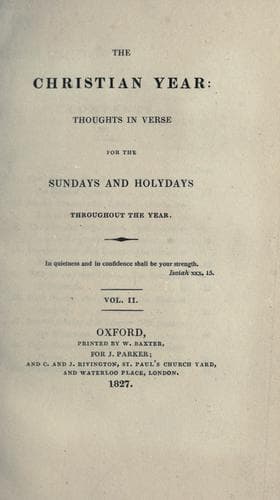
In 1827—when its author’s age was thirty-five—“The Christian Year” was
published. Like George Herbert, whose equal he was in piety though not
in power, Keble was joined to the Church in fullest sympathy with all its
ordinances, and desired to quicken worship by putting into each part of
the ritual a life that might pass into and raise the life of man. The
spirit of true religion, with a power beyond that of any earthly feuds
and controversies, binds together those in whom it really lives. Setting
aside all smaller questions of the relative value of different earthly
means to the attainment of a life hidden with Christ in God, Christians
of all forms who are one in spirit have found help from “John Keble’s
Christian Year,” and think of its guileless author with kindly affection.
Within five-and-twenty years of its publication, a hundred thousand
copies had been sold. The book is still diffused so widely, in editions
of all forms, that it may yet go on, until the circle of the years shall
be no more, living and making live.
Four years after “The Christian Year” appeared, Keble was appointed (in
1831) to the usual five years’ tenure of the Poetry Professorship at
Oxford. Two years after he had been appointed Poetry Professor, he
preached the Assize Sermon, and took for his theme “National Apostasy.”
John Henry Newman, who had obtained his Fellowship at Oriel some years
before the publication of “The Christian Year,” and was twenty-six years
old when it appeared, received from it a strong impulse towards the
endeavour to revive the spirit of the Church by restoring life and soul
to all her ordinances, and even to the minutest detail of her ritual.
The deep respect felt for the author of “The Christian Year” gave power
to the sermon of 1833 upon National Apostasy, and made it the
starting-point of the Oxford movement known as Tractarian, from the issue
of tracts through which its promoters sought to stir life in the clergy
and the people; known also as Puseyite because it received help at the
end of the year 1833 from Dr. Pusey, who was of like age with J. H.
Newman, and then Regius Professor of Hebrew. There was a danger, which
some then foresaw, in the nature of this endeavour to put life into the
Church; but we all now recognise the purity of Christian zeal that
prompted the attempt to make dead forms of ceremonial glow again with
spiritual fire, and serve as aids to the recovery of light and warmth in
our devotions.
Public-domain text, read in full here on John Shaqi.
Reviews
Reviews
No reviews yet
Be the first to share your thoughts on this work.
Join the Discussion
Join the discussion
Sign in to leave a comment or review.
Sign InorCreate an account