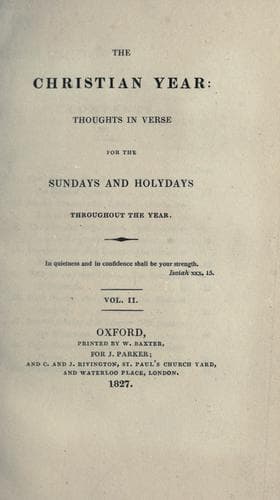
Christian poetry, English -- 19th century; Church year -- Poetry; Hymns, English
It was in 1833 that Keble, by one earnest sermon, with a pure life at the
back of it, and this book that had prepared the way, gave the direct
impulse to an Oxford movement for the reformation of the Church. The
movement then began. But Keble went back to his curacy at Hursley. Two
years afterwards the curate became vicar, and then Keble married. His
after-life continued innocent and happy. He and his wife died within two
months of each other, in the came year, 1866. He had taken part with his
friends at Oxford by writing five of their Tracts, publishing a few
sermons that laboured towards the same end, and editing a “Library of the
Fathers.” In 1847 he produced another volume of poems, “Lyra
Innocentium,” which associated doctrines of the Church with the lives of
children, whom he loved, though his own marriage was childless.
The power of Keble’s verse lies in its truth. A faithful and pure
nature, strong in home affections, full of love and reverence for all
that is of heaven in our earthly lot, strives for the full consecration
of man’s life with love and faith. There is no rare gift of genius.
Keble is not in subtlety of thought or of expression another George
Herbert, or another Henry Vaughan. But his voice is not the less in
unison with theirs, for every note is true, and wins us by its purity.
His also are melodies of the everlasting chime.
“And be ye sure that Love can bless
E’en in this crowded loneliness,
Where ever moving myriads seem to say,
Go—thou art nought to us, nor we to thee—away!”
“There are in this loud stunning tide
Of human care and crime,
With whom the melodies abide
Of the everlasting chime;
Who carry music in their heart
Through dusky lane and wrangling mart,
Plying their daily task with busier feet,
Because their secret souls a holy strain repeat.”
With a peal, then, of such music let us ring in the New Year for our
Library; and for our lives.
_January_ 1, 1887.
H. M.
DEDICATION.
WHEN in my silent solitary walk,
I sought a strain not all unworthy Thee,
My heart, still ringing with wild worldly talk,
Gave forth no note of holier minstrelsy.
Prayer is the secret, to myself I said,
Strong supplication must call down the charm,
And thus with untuned heart I feebly prayed,
Knocking at Heaven’s gate with earth-palsied arm.
Fountain of Harmony! Thou Spirit blest,
By whom the troubled waves of earthly sound
Are gathered into order, such as best
Some high-souled bard in his enchanted round
May compass, Power divine! Oh, spread Thy wing,
Thy dovelike wing that makes confusion fly,
Over my dark, void spirit, summoning
New worlds of music, strains that may not die.
Public-domain text, read in full here on John Shaqi.
Reviews
Reviews
No reviews yet
Be the first to share your thoughts on this work.
Join the Discussion
Join the discussion
Sign in to leave a comment or review.
Sign InorCreate an account