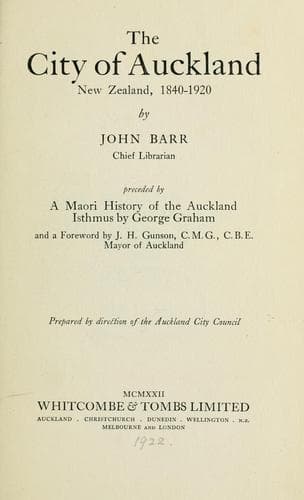
The City of Auckland, New Zealand, 1840-1920 — John Shaqi
The City of Auckland, New Zealand, 1840-1920Barr, John
History
The City of Auckland, New Zealand, 1840-1920
Barr, John
Auckland (N.Z.) -- History
This event was followed almost immediately by Te Koperu's brother, Te
Morenga, attacking the Tamaki pas, and he severely punished Ngati-Paoa,
amply revenging Te Koperu's death.
HONGI'S INVASION
The following year (1821) saw yet another attack on the people of
Tamaki. Hongi Ika himself first then came on the scene. He had just
returned from England, and had met Te Hinaki in Sydney, whence they
both returned to New Zealand. Te Hinaki had been warned in Sydney by
Hongi as to his intentions; he therefore prepared his fortifications
at Mokoia and Mauinaina for the storm about to break upon his people.
The Ngapuhi duly arrived and began a blockade of the Tamaki forts.
After a long siege, accompanied by much skirmishing, the Mokoia fort
was captured. Te Hinaki himself was slain, with a great number of
his people. After the incidents usual to such affairs had been fully
enacted, the Ngapuhi departed, to carry on the war in the districts of
Hauraki and the south.
For some years after the Ngapuhi invasion, the Tamaki Isthmus appears
to have been altogether abandoned as a permanent residential area. It
was during this time a kind of "no man's land." Ngati-Whatua retreated
to the forest wilderness of Waitakerei and Kaipara, or into the
recesses of the Waikato.
D'URVILLE'S VISIT
In 1827 D'Urville visited the Waitemata. He ascended Takarunga (Mount
Victoria, Devonport). Looking westward towards the Tamaki, he says
there were no signs whatever of any inhabitants. Crossing the harbour,
he found a deserted village (perhaps Orakei). He also attempted to
ascend what was probably Mount Eden, but had to abandon the attempt.
The denseness of growth of fern and scrub since the time of the
Ngati-Whatua conquest of the last century had obliterated all the old
native tracks. The greater area of the Isthmus had become little better
than a jungle of vegetation.
D'Urville also describes his visit to the villages at Tamaki, where a
namesake of the late ill-fated Hinaki was then head man.
NGAPUHI DEFEATED AT TAMAKI HEADS
In this year (1827) was fought the last tribal battle in Tamaki. The
Manukau and Ngati-Whatua people in alliance came in canoes down the
Tamaki River to give combat to Ngapuhi. That people, crossing from
Waiheke, "captured" the apparently abandoned canoes of the local people
at the West Tamaki Head. While Ngapuhi were quarrelling over the
supposed "spoils of war," the allies returned and surprised them, with
such success that only one small Ngapuhi party of twenty men returned
home to tell the tale.
THE COMING OF CHRISTIANITY
Christianity was now beginning to show its influence among the
war-weary tribes of New Zealand, and from now on until 1835 much
inter-tribal peacemaking was the order of the day.
Public-domain text, read in full here on John Shaqi.
Reviews
Reviews
No reviews yet
Be the first to share your thoughts on this work.
Join the Discussion
Join the discussion
Sign in to leave a comment or review.
Sign InorCreate an account