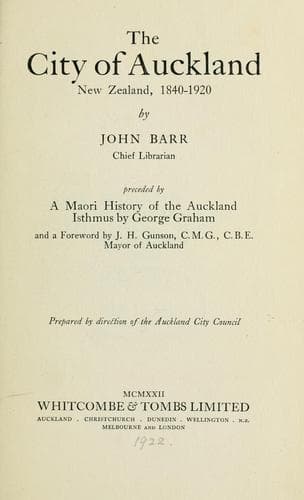
The City of Auckland, New Zealand, 1840-1920Barr, John
History
The City of Auckland, New Zealand, 1840-1920
Barr, John
Auckland (N.Z.) -- History
In that year Ngati-Whatua began to return to the Isthmus, but none of
the old hill forts were re-occupied. The decrease in population, the
introduction of firearms, and the general change in the modes of life
had made those elevated places of abode impracticable under the new
conditions which arose.
Okahu (Orakei Bay) became the headquarters of the Ngati-Whatua; they
had also a large village at Mangere, where also lived Kati, younger
brother of Te Wherowhero,[3] the paramount Waikato chief. His
wife--Matere Toha--was a Ngapuhi chieftainess of high rank, being
a niece of the great Hongi Ika.[4] Apihai Te Kawau, head chief of
Ngati-Whatua, took up his residence at Orakei, and other villages were
established and occupied on the shores of the Waitemata and Manukau.
This was the position in 1840.
The days of local inter-tribal warfare had now passed away for ever. In
this year the purchase of the site of Auckland City took place, and the
British Flag was unfurled at Fort Britomart. Thus closed the long and
troublous history of Tamaki-Makau-Rau.
[Illustration: Auckland, 1840, showing the Tents of First Settlers
All the bays have been reclaimed and the Point demolished]
THE CITY OF AUCKLAND NEW ZEALAND 1840-1920
_by_ JOHN BARR
Chapter I
_Foundation and Settlement (1840-1850)_
The City of Auckland was founded on the 18th September, 1840, by
Captain William Hobson, R.N., Lieutenant-Governor of New Zealand.
Captain Hobson, on his arrival in New Zealand, made his headquarters
at the Bay of Islands, at that time the most populous place in
the colony, as far as white people were concerned, for here both
missionaries and traders had settled in greatest numbers, and here,
also, Mr. Busby, British Resident, was located. The Bay of Islands did
not meet with the approval of the Lieutenant-Governor, and, in his
first conversation with the Rev. Henry Williams,[5] he asked for his
opinion as to the most suitable place to erect the capital of the young
colony. The Archdeacon recommended the Tamaki or the Waitemata. The
Surveyor-General, Mr. Felton Mathew, visited both these localities,
and favoured Tamaki, which, if his recommendation had been adopted,
would have placed the seat of Government where Panmure now stands.
Captain Hobson, however, decided to investigate the sites himself, and
in company with Mr. G. Clarke, Protector of Aborigines, and Captain
David Rough, who was appointed "Harbour Master at Waitemata" in August
of this year, he sailed in the Revenue cutter _Ranger_, commanded by
Captain Carkeek, from the Bay of Islands at the end of June, 1840.
After inspecting the channel at the Tamaki, the Lieutenant-Governor
decided against that site. He then visited the upper reaches of the
Waitemata Harbour, and was again dissatisfied with the channel.
However, as Captain Rough had left the vessel to take soundings near
the Ponsonby shore, and on the report of these being satisfactory,
Public-domain text, read in full here on John Shaqi.
Reviews
Reviews
No reviews yet
Be the first to share your thoughts on this work.
Join the Discussion
Join the discussion
Sign in to leave a comment or review.
Sign InorCreate an account