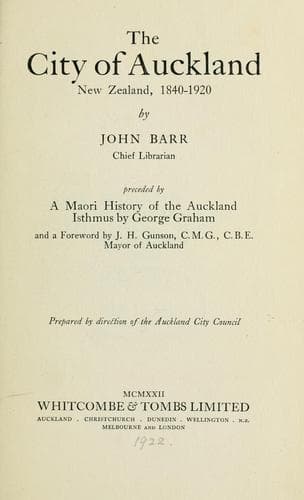
The City of Auckland, New Zealand, 1840-1920Barr, John
History
The City of Auckland, New Zealand, 1840-1920
Barr, John
Auckland (N.Z.) -- History
ways, as I have already stated. We had parsons without churches, and
magistrates without courts; but we scrambled through our divinity and
our law somehow or other.... For instance, here is an entry of date
15th May [1841]. 'To-day saw Mr. ---- sitting in front of his _whare_
administering justice under the canopy of heaven.'"
Another interesting description of Auckland in its cradle days is given
in the Diary of Mr. Robert Graham, one of the immigrants by the _Jane
Gifford_, which arrived in Auckland on October 9th, 1842. Under the
date October 12th, he records:--
"The town of Auckland lies in a hollow, and the houses are built close
down to the beach. Some of them are very 'natty'. Shortland Street
appears to be the principal street. In the meantime, the first shop
is a grog shop; the next is Mr. McLennan's; the third a shoemaker's;
the fourth a baker's; then a grog shop; next a pork stand; and then
another grog shop. There seems to be a grog shop for every three of all
the other trades put together. Shortland Crescent is a pretty steep
hill. On the top of it is the church, the Customs-house, bank and the
public buildings, and adjacent the barracks. A road leads to Manukau,
a distance of ten miles, where a coach can run the whole way. Mr. Gould
and I went out this road four miles to a place called Epsom. There is
a little cultivation going on there, but none nearer the town. Saw
some nice cottages and fine gardens, and two farms of about ten acres,
each under cultivation in wheat and barley. There were also two herds
of cattle with bells on their necks to indicate their whereabouts
when in the fern, which is everywhere around. Observed one plough at
work, drawn by two bullocks. The Maoris to be seen about are seemingly
quite happy, fond of smoking; and appear to have pork, fish and
potatoes in abundance. They are intelligent looking, have most pleasant
countenances, and are all mostly tatooed, the chiefs in particular
being elaborately so."
[Illustration: Plan of Auckland, 1842
At this date the waters of the Waitemata Harbour reached Lower Queen
Street at a point opposite Shortland Street where a streamlet known as
the Ligar Canal ran into the Bay.
_After the original in the Old Colonists' Museum_]
The following tables, taken from Charles Terry's "New Zealand; Its
Advantages and Prospects as a British Colony" (pp. 60-61), show the
cost of living at that time, and make an interesting comparison with
the cost of living at the present time:--
_Price of Provisions at Auckland, July, 1841_
s. d.
Beef per lb 1 4
Mutton " 1 0
Pork " 0 7
Flour " 0 5
Bread " 0 7
Cheese, English " 2 0
Butter, Irish " 2 6
Tea " 10 0
Coffee " 2 6
Sugar, brown " 0 6
" refined " 1 0
Rice " 0 4
Potatoes, per cwt. 8 0
Public-domain text, read in full here on John Shaqi.
Reviews
Reviews
No reviews yet
Be the first to share your thoughts on this work.
Join the Discussion
Join the discussion
Sign in to leave a comment or review.
Sign InorCreate an account