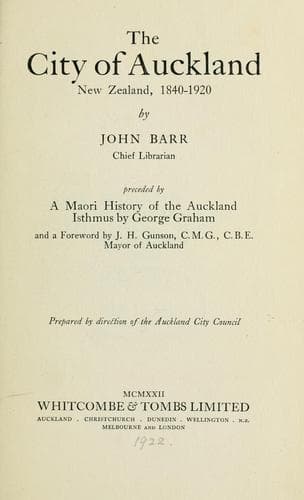
The City of Auckland, New Zealand, 1840-1920Barr, John
History
The City of Auckland, New Zealand, 1840-1920
Barr, John
Auckland (N.Z.) -- History
_Rents and Lodging_
Wooden Houses, unfurnished Two small rooms and kitchen,
£60 to £80 per annum
Lodgings, unfurnished One small room, £1 per week
Board and Lodging Board, being without malt or spirituous
liquors, and Lodging, a bed in a room
with others, £2 per week
_Wages_
Carpenters 16s. to 20s. per day
Brickmakers 10s. per day
Labourers 8s. per day
Men Servants £4 per month, and board
Maid Servants £36 per annum, and board
Boys 10s. per week, and board
After the Government had established itself at Auckland, one of the
first duties which it undertook was to provide settlers with land. On
April 19-20, 1841, the first sale of town lots by auction was held,
and the figures realised were stupendous, due to jobbing, which land
sharks from Sydney and other parts of Australia had fostered. According
to the official "Gazette," only 116 allotments were sold, the total
area comprising 38 acres 1 rood 28 perches, realising £21,299 9s. In
addition, twelve allotments measuring 5 acres 3 roods 2½ perches were
reserved for Government officers, and realised £2,976 8s. 9d.
Among the names of the purchasers will be found some of Auckland's most
respected citizens, who had the confidence, even in those early days,
that Auckland was destined to be a big city.
The size of the town allotments varied from approximately a quarter to
half an acre. The plan of the town was the work of Mr. Felton Mathew,
Surveyor-General, its principal features being a circus where Albert
Park now stands, balanced on the western side of Queen Street by a
square, into which Hobson Street and Victoria Street now intersect.
The sections were designed so that they had a double front, one to
the main street, the other to a lane. Some of these lanes survive to
the present, for example, High Street. The principal streets were 66
feet wide, the secondary streets 33 feet, and the lanes somewhat less.
Unfortunately for the city's future, the owners of sections subdivided
their lots, and the lanes automatically became important thoroughfares.
To-day these narrow streets are completely congested with the traffic,
and widening operations must inevitably take place. O'Connell Street,
one of those lanes (where the first wooden house[15] erected in
Auckland stood for some eighty years), has just undergone this process
of widening, and others must follow.
Public-domain text, read in full here on John Shaqi.
Reviews
Reviews
No reviews yet
Be the first to share your thoughts on this work.
Join the Discussion
Join the discussion
Sign in to leave a comment or review.
Sign InorCreate an account