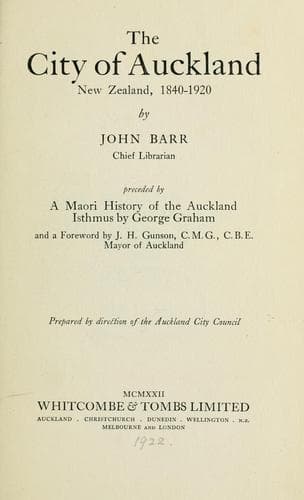
The City of Auckland, New Zealand, 1840-1920 — John Shaqi
The City of Auckland, New Zealand, 1840-1920Barr, John
History
The City of Auckland, New Zealand, 1840-1920
Barr, John
Auckland (N.Z.) -- History
In 1851 there occurred an incident, which, ending happily, might
have had serious consequences. The beginning of the affair was the
apprehension of a native named Ngawiki, of the Ngati-Tamatera (Thames)
by the police for the theft of a shirt. An attempt was made by the
chief of the Ngati-Paoa and some others to rescue the criminal, and a
street row ensued, in the course of which a native constable struck
the chief with his staff several blows on the head, and succeeded in
holding the prisoner. The _fracas_ resulted in a native expedition from
Waiheke on April 17th against the town. This force, which consisted
of 250 armed men, was led by a chief named Ngakapa. They landed at
Mechanics Bay, where they danced hakas and used threatening language.
With reinforcements, which they expected, they hoped to number from
600 to 800 men. As the military and naval forces within the capital
did not amount to 400 men, the situation looked serious, and Governor
Sir George Grey at once took steps to ward off the danger. He sent a
message by the Commissioner of Police (Captain Beckham) to the natives,
"informing them that they must either return to their homes within
the space of two hours, or give up their arms, and that in the event
of their non-compliance with these terms measures would be taken to
disarm them at the expiration of the time specified." This ultimatum
proved effective, and the party retired to Okahu (Orakei). There the
war party met with some reinforcements, but the failure of the invading
force, combined with the efforts of the Ngati-Whatua chiefs of Orakei,
who advised the newcomers not to take part in the insurrection,
resulted in the reinforcements deciding not to participate further
in the affair. Instead, they ridiculed the men who had taken part in
the expedition "for having been compelled at low water to drag their
canoes over the extensive mud flats in the vicinity of this town." The
incident ended with an expression of regret by the principal chiefs
of the war party, and the voluntary surrender of their greenstone
meres to the Governor. The preparations for the defence of the town
were made by Lieutenant-Colonel Wynyard, in co-operation with Captain
Oliver, commanding H.M.S. _Fly_. The pensioners in their several
villages placed themselves under arms. Sir George Grey, in a special
despatch, gives "especial credit to Major Kenny, of the first battalion
of pensioners, who arrived in Auckland with a reinforcement of 200
pensioners in a shorter period of time than I believed it possible for
them to have assembled and to have performed a march of about six and a
half miles."
The pensioners mentioned above were a body of time-expired regulars,
who had been brought to New Zealand, the pioneers of the force
having arrived in Auckland on August 5th, 1847, under the command of
Lieutenant-Colonel Bolton, R.E., and Captain Kenny, named in the above
despatch.
[Illustration: Auckland, 1862
Maori War Canoe Race (Annual Regatta) in progress
Public-domain text, read in full here on John Shaqi.
Reviews
Reviews
No reviews yet
Be the first to share your thoughts on this work.
Join the Discussion
Join the discussion
Sign in to leave a comment or review.
Sign InorCreate an account