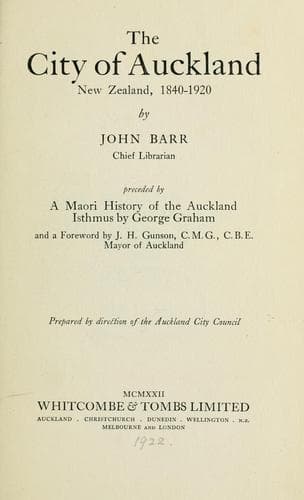
The City of Auckland, New Zealand, 1840-1920 — John Shaqi
The City of Auckland, New Zealand, 1840-1920Barr, John
History
The City of Auckland, New Zealand, 1840-1920
Barr, John
Auckland (N.Z.) -- History
_F. R. Stack, delt._]
The native constables who took part in this incident did not long
survive the event. It may, in fact, come as a surprise to many that
there ever were native policemen, and it may be interesting to
describe the appearance of these officers of the law. Their attire
was a semi-military, blue uniform, resplendent with buttons, white
facings and side stripes. They carried substantial bludgeons, which, as
shown, they knew how to use, and did not scruple to do so. Two of these
defenders of the peace are depicted in one of Hogan's views (_f._ p.
77).
The discovery of gold at Coromandel, in 1852, was an important event
in the history of Auckland and in the development of the resources
of the province. The gold finds in Victoria gave the impetus to New
Zealand, and prospecting parties began to work. But it was not until
a "Reward Committee" was formed at Auckland, with Mr. Frederick
Whitaker as chairman, that any steps were taken to prove the rumours
that gold was available in New Zealand. In October, 1852, a reward
of £500 was "offered to the first person who should discover and
make known to the 'Reward Committee' 'a valuable gold find' in the
northern district of New Zealand. Within less than a week the reward
was claimed by Mr. Charles Ring, a New Zealand settler, recently
returned from California, who asserted that he had discovered
gold in the neighbourhood of Coromandel Harbour."[25] Mr. Ring's
claim was thereupon investigated, and a sub-committee visited the
locality (Driving Creek). On their return, the committee was able
to announce that the sub-committee's report "is satisfactory, in so
far as the existence of gold is concerned, but that the question of
its being sufficiently abundant to be profitably worked is yet in
abeyance."[26] As native rights were involved in connection with the
land, negotiations had to be entered upon before the gold could be
worked. The Government therefore stepped in, and were successful in
their efforts with the natives, of whom the chief was Taniwha, an old
man, who in his boyhood had met Captain Cook, and on November 30th
an agreement was signed regulating the management of the goldfield.
On 11th December the first sale of gold was held by Messrs. Connell
and Ridings, Auckland, and realised £32 1s. In a short time a 'rush'
to Coromandel took place, and about 3000 miners were at work on the
diggings. Between 1857 and 1860 a slump took place, but a revival was
experienced in 1861. During the Maori war another slack period was
felt, but after hostilities had ceased, work was resumed, and has
continued ever since.
Although Coromandel never produced the gold expected from it, it
opened up a new industry, which has grown to a considerable extent,
and has been the means of attracting population to the province, and
has indirectly affected the growth of Auckland, the chief city of the
province.
Public-domain text, read in full here on John Shaqi.
Reviews
Reviews
No reviews yet
Be the first to share your thoughts on this work.
Join the Discussion
Join the discussion
Sign in to leave a comment or review.
Sign InorCreate an account