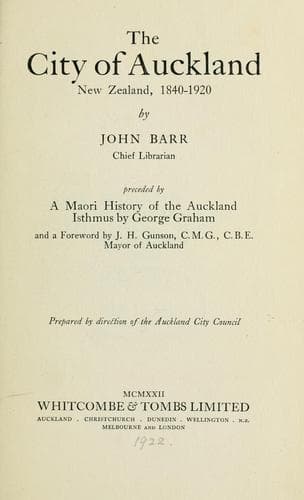
The City of Auckland, New Zealand, 1840-1920Barr, John
History
The City of Auckland, New Zealand, 1840-1920
Barr, John
Auckland (N.Z.) -- History
At no time did the scene of hostilities reach the town of Auckland,
but in July, 1863, Mr. Meredith and his son were murdered in barbarous
fashion, and on October 26th of the same year two sons of Mr. Trust
were killed near Howick, about fifteen miles from Auckland.
During the years 1863-64 the entire adult male population of Auckland
was enlisted for compulsory service either in the militia, volunteers
or fire brigade, and had to undergo military training. Some of the
conscripts remained in the barracks both day and night, while others
did duty at the various blockhouses placed on points of vantage
overlooking the district. The blockhouses were situated where the
Auckland Hospital now stands, and at Domain Hill, Parnell, Newmarket,
Karangahape Road, Great North Road, and Freeman's Bay. The coast-line
was also guarded. On July 22nd, 1863, the Auckland First Class Militia
and Volunteers joined the field force, and did duty on the Wairoa
River. In February, 1864, the Second Class of Militia, comprising
business and tradespeople, were ordered on active service, and a
contemporary newspaper feared that, if the enlistments continued, the
shops of the town would have to close and put up notices: "Gone to the
front."
The electric telegraph was introduced into the Auckland Province during
the war of 1863, when a line was erected under great difficulties
between the important military stations at Drury and Queen's Redoubt.
Covering parties were engaged to protect the workers, who were also
armed, in case of emergencies. The first telegraph office erected in
Auckland was a wooden hut, located in the Albert Barracks, just inside
the barracks wall, Symonds Street. This was the terminal of a single
wire which General Cameron had from his office to the Otahuhu Military
Camp near Anne's Bridge. The first operator was Mr. Alex. Brodie, of
the Royal Engineers. About 1866, this office was removed to the Post
Office, Princes Street. By October, 1864, there were 160 miles of
telegraph lines in the province, but communication with Wellington
and the South Island was not established until 1872. Four years later
Australia and Great Britain were brought into telegraphic connection
with New Zealand.
One of the happy results of the war in the Waikato was the discovery
of coal on the banks of the Waikato River, in July, 1863, which
was immediately used on the river-boats engaged in the war. After
hostilities had ceased, the coal fields were exploited, and the
beginning of the successful coal-mining industry at Huntly established.
In March of the following year coal was discovered at Kawakawa, and
from these sources were obtained supplies for the domestic use of
Auckland residents and for the commercial needs of the town and
province.
Public-domain text, read in full here on John Shaqi.
Reviews
Reviews
No reviews yet
Be the first to share your thoughts on this work.
Join the Discussion
Join the discussion
Sign in to leave a comment or review.
Sign InorCreate an account