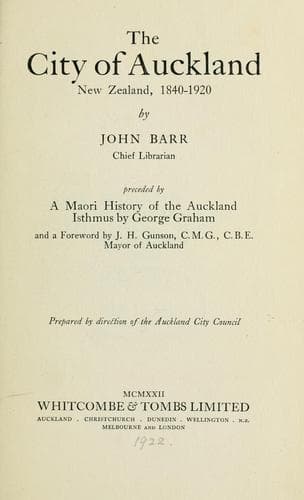
The City of Auckland, New Zealand, 1840-1920Barr, John
History
The City of Auckland, New Zealand, 1840-1920
Barr, John
Auckland (N.Z.) -- History
Another direct result of the war was the inauguration of the railway
system of the North Island, although such a step would have taken place
in due course. The initial movement was made by the Provincial Council
in 1863, when a report was adopted recommending the construction of a
railway between Auckland and Drury, with a branch line to Onehunga.
Tenders were accordingly invited in the following year, the offer
of Messrs. Brogden and Sons, an English firm, being accepted. The
work commenced on 17th February, 1865. Parnell Hill was pierced by a
tunnel on July 31st, 1872, and the Auckland-Onehunga portion of the
line was opened on December 24th, 1873. The Auckland station was then
situated on the harbour at the eastern side of Point Britomart, near
the end of Custom-House Street [now Customs Street]. The growth of the
railway system of the province was slow, and by the end of 1877 only 93
miles had been completed. With the demolition of Point Britomart the
railway station was removed to its present location, being completed
on October 26th, 1885. It would be interesting to trace step by step
the extension of the railway system, as, obviously, it is part of the
history of Auckland, but, in so brief a sketch as this, detail is
impossible. It is worth mentioning, however, that the first Main Trunk
train from Wellington to Auckland arrived on November 6th, 1908, and
that the daily express between here and the capital was inaugurated on
February 14th, 1909.
Travelling overland prior to the introduction of railways, and for many
years after, was conducted by coaches. In the earliest days this means
of locomotion was restricted, but increased with the opening up of the
province and the development of the roads. Thus, in 1867, there was
established a daily service of coaches to Hamilton. The coaches were
of the type known as "Cobb & Co.", an exceedingly picturesque vehicle,
with dickys for the driver and for passengers at the rear. The most
extensive and famous line of coaches were those owned by Messrs. Quick
Bros.
The city and suburban conveyances were at first busses, and, later,
horse-drawn Albert cars. As early as 1864 there was a half-hourly
service of busses to Onehunga.
Public-domain text, read in full here on John Shaqi.
Reviews
Reviews
No reviews yet
Be the first to share your thoughts on this work.
Join the Discussion
Join the discussion
Sign in to leave a comment or review.
Sign InorCreate an account