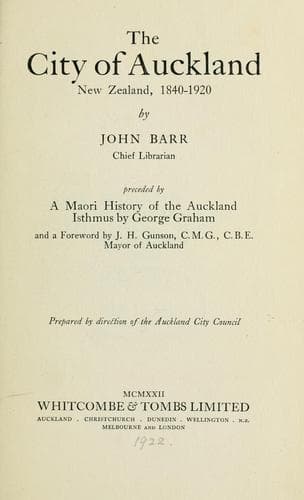
The City of Auckland, New Zealand, 1840-1920 — John Shaqi
The City of Auckland, New Zealand, 1840-1920Barr, John
History
The City of Auckland, New Zealand, 1840-1920
Barr, John
Auckland (N.Z.) -- History
The Arawa people at an early date also contributed its quota to
the population of Tamaki. Arriving on the East Coast (at the same
time and place as the Tainui) this canoe likewise made a coastal
exploration. Eventually its people settled down at Maketu (Bay of
Plenty), Tamatekapua, their leader, having remained at Moehau (Cape
Colville), where he died. From there his children spread throughout
the Coromandel peninsula and the islands of the Gulf, and were known
as Ngati-huarere (Huarere being Tamatekapua's grandson). We are told
that Ihenga, a brother of Huarere, lived at Tamaki for some time, and
at Kaipara. These early Arawas left descendants here, and through them
the Tamaki chiefs thus claimed an Arawa lineage. The Ngati-Huarere are
said to have occupied fortified villages at Orakei, Fort Britomart,
Queen Street, Three Kings and other places, until the final conquest
of the Tamaki Isthmus, as hereinafter related. Kahumatamomoe, another
son of Tamatekapua, having quarrelled with his brothers and relatives
at Maketu, came to Tamaki, and is said to have lived at Orakei with
other relatives already settled there, hence the name of the village at
Orakei--"Okahu." Going on to Kaipara, he permanently resided there.
VI
_The Matatua Canoe_
This immigrant canoe was also an important factor in populating
the Tamaki Isthmus. Its people had settled at Whakatane, and were
remarkable for their restlessness. Parties of this tribe, known under
the general name of Ngati-Awa, were always on the move. They are
reputed to have formed an important element of the One Tree Hill
(Maungakiekie, lofty hill) people. The Owairaka (Mount Albert) pa
belonged to this people. The Ngati-Awa chief Titahi, who lived in
Tamaki and Kaipara for some time, is said to have instructed the local
people how to perfect their fortifications. Hence one name for the
terracing and earthworks (so conspicuous a feature of the hills of
Tamaki) was "Nga-whaka-iro-a Titahi"--"The decorations of Titahi."
The intrusion of these various immigrant parties no doubt was not
peacefully accomplished, and almost continuous warfare marks the
history of the next few centuries, as the direct result of the jealousy
between rival chieftains and the struggles of the respective tribes to
maintain and extend their territories.
VII
_The Aotea Canoe_
Public-domain text, read in full here on John Shaqi.
Reviews
Reviews
No reviews yet
Be the first to share your thoughts on this work.
Join the Discussion
Join the discussion
Sign in to leave a comment or review.
Sign InorCreate an account