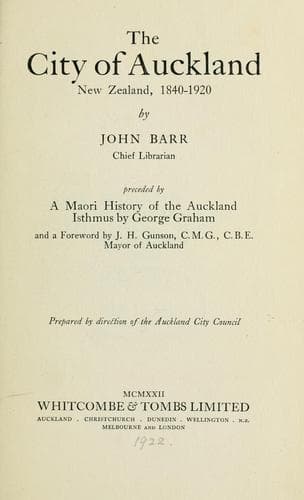
The City of Auckland, New Zealand, 1840-1920Barr, John
History
The City of Auckland, New Zealand, 1840-1920
Barr, John
Auckland (N.Z.) -- History
At early dawn the people were astir and about their daily duties.
After the morning meal, the cultivators went forth to the plantations,
the fishers to the sea, and the hunters to the forest. Other men were
engaged in the building of houses or canoes, in which the art of the
carver was utilised, or in the making of stone implements or weapons,
whilst the women of rank directed and actively took part in the
domestic arts--garment weaving, mat and kit plaiting, etc.
No individual was idle; to be so was a reproach, and a failing not
tolerated. The whole idea pervading the community was the public weal,
and each individual did his or her "bit," not for individual profit,
but _pro bono publico_.
At sundown the people withdrew to their villages for the night. The
gateways were closed, and sentries were posted on the parapets. By
their watch-songs and calls throughout the night, the sentries answered
one another from village to village.
Within doors the communities, by night, amused themselves and their
visitors with dancing, songs and folk-tales of ancestral doings. Such
relaxation is, indeed, the feature of Maori village life at the present
day.
The burial-places of the people were the caverns of the Isthmus,
each sub-tribe and family having its own place of sepulchre. In some
cases these were in remote places of the forests of Waitakerei, or
other secluded localities. Of the many other aspects of ancient Maori
social economy, religious rites, etc., and, above all, of the customs
connected with war, I must refer those interested to the many excellent
books dealing with the subject.
The above sketch will, however, give an idea of the social status
of the people in those ancient times, when the events hereinafter
described were enacted.
IX
_The Wars of Tamaki_
It is hard to ascertain the actual causes and the chronological
sequence of the wars which followed the arrival of the fleet, and only
an outline is attempted here.
MAKI'S INVASION FROM WAIKATO
This chief, Maki, came from Ngati-Awa of Taranaki. Coming northward
with his people he seemed to have gradually worked his way _via_
Kawhia and Waikato to Tamaki, capturing the Rarotonga (Mount Smart)
pa, where for a time he dwelt. Here he was visited by the chiefs of
Kaipara, descendants of Titahi. They requested his assistance in
warfare against the Kawerau, an ancient aboriginal people, who had
become intermixed with the Tini-o-Toi. Responding to this invitation,
and reinforced by a large section of Tamaki people, he invaded Kaipara
with great success, attacking ultimately, like Strongbow of old, the
people whom he had come to assist. He then turned his attention to the
Waitakerei and Mahurangi districts, with like results, and extended his
doings to the outlying islands--Tiritiri, Kawau and Waiheke, finishing
up at Maraetai. Afterwards he departed as he came, returning, it is
said, to the southern districts of Taranaki.
KAWHARU'S INVASION FROM KAIPARA
Public-domain text, read in full here on John Shaqi.
Reviews
Reviews
No reviews yet
Be the first to share your thoughts on this work.
Join the Discussion
Join the discussion
Sign in to leave a comment or review.
Sign InorCreate an account