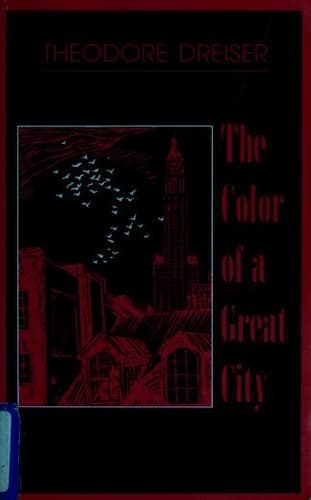
New York (N.Y.) -- Description and travel; New York (N.Y.) -- Social conditions
Yet meantime the city sings of its happiness, the lights burn, the
autos honk; there are great restaurants agleam with lights and
merriment. See, that is where strength is!
I like this fact of the man on the bench, as sad as it is. It is the
evidence of the grimness of life, its subtlety, its indifference. Men
pass them by. The world is elsewhere. And yet I know that below all
this awaits after all the unescapable chemistry of things. They are
not out of nature. They cannot escape it really. They are of it--an
integral part of the great mystery and beauty--even they. They fare ill
here, now, perhaps--very. Yet it is entirely possible that they need
only wait, and life will eventually come round to them. They cannot
escape it; it must use them. The potter has but so much clay. He cannot
but mold it again and again. And as for the fire, He cannot ultimately
prevent it. It goes, somewhat wild or mild, into all He does.
THE MEN IN THE DARK
It is not really dark in the accepted sense of the word, for a great,
yellow, electric lamp sputtering overhead casts a wide circle of gold,
but it is one-fifteen of a cold January morning, and this light is
all the immediate light there is. The offices of the great newspaper
center, the sidewalk in front of one of which constitutes the stage of
this scene, are dark and silent. The great presses in every newspaper
building hereabouts are getting ready to whir mightily, and if only
the passers-by would cease their shuffling you could hear the noises
of preparation. A little later, when they are actually in motion, you
can hear them, a sound of rushing, dim and muffled, but audible--the
cataract of news which the world waits for, its daily mental stimulus,
not unlike the bread that is left at your door for your body.
But who are these peculiar individuals who seem to be gathering here
at this time in the morning? You did not notice any one a few minutes
ago, but now there are three or four over there discussing the reasons
for the present hard times, and here in the shadow of this great arch
of a door are three or four more. And now you look about you and they
are coming from all directions, slipping in out of the shadow toward
this light, where sits a fat old Irish woman beside an empty news-stand
waiting to tend it, for as yet there is nothing on it. They all seem
at first to be men of one type, small and underweight and gaunt. But a
little later you realize that they are not so much alike in height and
weight as you first thought, and of differing nationalities. But they
are all cold, though, that is certain, and a little impatient. They are
constantly shifting and turning and looking at the City Hall clock,
where its yellow face shows the hour, or looking down the street, and
sometimes murmuring, but not much. There is very little said.
“What is all the trouble?” you ask of some available bystander, who
ought to be fairly _en rapport_ with the situation, since he has been
standing here for some time.
Public-domain text, read in full here on John Shaqi.
Reviews
Reviews
No reviews yet
Be the first to share your thoughts on this work.
Elsewhere in the archive
Join the Discussion
Join the discussion
Sign in to leave a comment or review.
Sign InorCreate an account