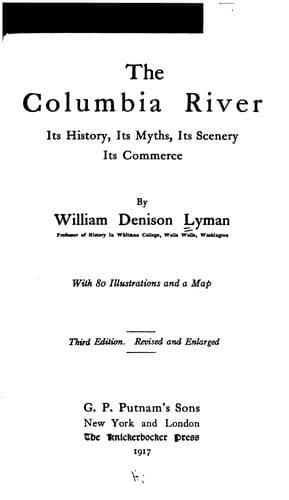
The Columbia River: Its History, Its Myths, Its Scenery, Its CommerceLyman, William Denison
History
The Columbia River: Its History, Its Myths, Its Scenery, Its Commerce
Lyman, William Denison
Columbia River; Columbia River -- Description and travel; Columbia River -- History
Pending the meeting, there was a general policy of opposition developed
among the French Canadians in the interest of the Hudson's Bay Company and
England. This opposition threatened the overthrow of the entire plan. It
was, however, checkmated in an interesting fashion. George W. Le Breton
was one of the leading settlers and occupied a peculiar position. He was
of French origin, from Baltimore to Oregon, and had been a Catholic. His
existing affiliations were with the Americans. He was keen, facile, and
well educated. He discovered that the Canadians had been drilled to vote
"No" on all questions, irrespective of the bearing which such a vote might
have on the leading issue. Le Breton accordingly proposed that measures be
introduced upon which the Canadians ought to vote "Yes." These tactics
were carried out. The Canadians were confused thereby. Le Breton watched
developments carefully and, becoming satisfied that he could command a
majority, rose and exclaimed, "We can risk it, let us divide and count!"
Gray shouted, "I second the motion!" Jo Meek, famous as one of the
Mountain Men, stepped out of the crowd and said, "Who is for a divide? All
in favour of an organisation, follow me!" The Americans speedily gathered
behind the tall form of the erstwhile trapper. A count followed. It was a
close vote. Fifty-two voted for, and fifty against. The Americans would
have been outvoted had it not been that Le Breton, with two French
Canadians, Francois Matthieu and Etienne Lucier, voted with them. The
defeated Canadians withdrew, and the Indians, who lined the banks of the
River to discover what strange proceedings the white men were engaged in,
perceived from the loud shouts of triumph that the "Bostons" had won.
Though the victory was gained by so scanty a margin, it was gained, and it
was decisive. It was one of the most interesting events in the history of
Oregon or the United States, for it illustrates most vividly the inborn
capacity of the American for self-government.
The new government went at once into effect. The constitution formulated
by the committee and adopted by the meeting at Champoeg provided that the
people of Oregon should adopt laws and regulations until the United States
extended its jurisdiction over them. Freedom of worship, habeas corpus,
trial by jury, proportionate representation, and the usual civil rights of
Americans were guaranteed. Education should be encouraged, lands and
property should not be taken from Indians without their consent. Slavery
or involuntary servitude should not exist.
Public-domain text, read in full here on John Shaqi.
Reviews
Reviews
No reviews yet
Be the first to share your thoughts on this work.
Elsewhere in the archive
Join the Discussion
Join the discussion
Sign in to leave a comment or review.
Sign InorCreate an account