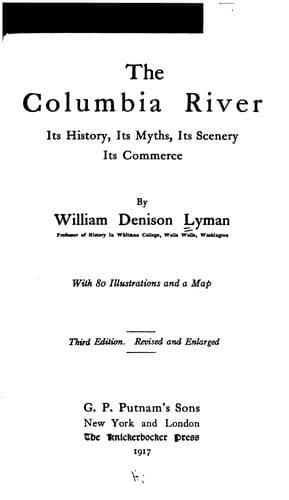
The Columbia River: Its History, Its Myths, Its Scenery, Its CommerceLyman, William Denison
History
The Columbia River: Its History, Its Myths, Its Scenery, Its Commerce
Lyman, William Denison
Columbia River; Columbia River -- Description and travel; Columbia River -- History
The author enjoyed the great privilege of descending the Dalles in the _D.
S. Baker_ in the year 1888, Captain Troup being in command. At that
strange point in the River, the whole vast volume is compressed into a
channel but one hundred and sixty feet wide at low water and much deeper
than wide. Like a huge mill-race this channel continues nearly straight
for two miles, when it is hurled with frightful force against a massive
bluff. Deflected from the bluff, it turns at a sharp angle to be split in
sunder by a low reef of rock. When the _Baker_ was drawn into the suck of
the current at the head of the "chute" she swept down the channel, which
was almost black, with streaks of foam, to the bluff, two miles in four
minutes. There feeling the tremendous refluent wave, she went careening
over and over toward the sunken reef. The skilled captain had her
perfectly in hand, and precisely at the right moment, rang the signal
bell, "Ahead, full speed," and ahead she went, just barely scratching her
side on the rock. Thus close was it necessary to calculate distance. If
the steamer had struck the tooth-like point of the reef broadside on, she
would have been broken in two and carried in fragments on either side.
Having passed this danger point, she glided into the beautiful calm bay
below and the feat was accomplished. Captain J. C. Ainsworth and Captain
James Troup were the two captains above all others to whom the company
entrusted the critical task of running steamers over the rapids.
In the _Overland Monthly_ of June, 1886, there is a valuable account by
Captain Lawrence Coe of the maiden journey of the _Colonel Wright_ from
Celilo up what they then termed the upper Columbia.
This first journey on that section of the River was made in April, 1859.
The pilot was Captain Lew White. The highest point reached was Wallula,
the site of the old Hudson's Bay fort. The current was a powerful one to
withstand, no soundings had ever been made, and no boats except canoes,
bateaux, flatboats, and a few small sailboats, had ever made the trip. No
one had any conception of the location of a channel adapted to a
steamboat. No difficulty was experienced, however, except at the Umatilla
Rapids. This is a most singular obstruction. Three separate reefs, at
intervals of half a mile, extend right across the River. There are narrow
breaks in these reefs, but not in line with each other. Through them the
water pours with tremendous velocity, and on account of their irregular
locations a steamer must zigzag across the River at imminent risk of being
borne broadside on to the reef. The passage of the Umatilla Rapids is not
difficult at high water, for then the steamer glides over the rocks in a
straight course.
Public-domain text, read in full here on John Shaqi.
Reviews
Reviews
No reviews yet
Be the first to share your thoughts on this work.
Elsewhere in the archive
Join the Discussion
Join the discussion
Sign in to leave a comment or review.
Sign InorCreate an account