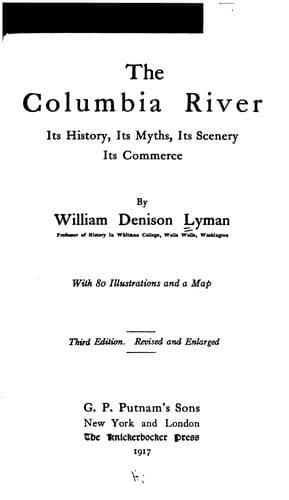
The Columbia River: Its History, Its Myths, Its Scenery, Its CommerceLyman, William Denison
History
The Columbia River: Its History, Its Myths, Its Scenery, Its Commerce
Lyman, William Denison
Columbia River; Columbia River -- Description and travel; Columbia River -- History
In the August _Overland_ of the same year, Captain Coe narrates the first
steamboat trip up Snake River. This was in June, 1860, just at the time of
the beginning of the gold excitement. The _Colonel Wright_ was loaded with
picks, rockers, and other mining implements, as well as provisions and
passengers. Most of the freight and passengers were put off at Wallula, to
go thence overland. Part continued on to test the experiment of making way
against the wicked-looking current of Snake River. After three days and a
half from the starting point a few miles above Celilo, the _Colonel
Wright_ halted at a place which was called Slaterville, thirty-seven miles
up the Clearwater from its junction with the Snake. There the remainder
of the cargo was discharged, to be hauled in waggons to the Oro Fino
mines. The steamer _Okanogan_ followed the _Colonel Wright_ within a few
weeks, and navigation on the Snake may be said to have fairly begun.
During that same time the city of Lewiston, named in honour of Meriwether
Lewis, the explorer, was founded at the junction of the Snake and
Clearwater rivers.
While parts of the Columbia and it chief tributary, the Snake, were thus
opened to navigation by 1860, no "fire-canoe" had yet appeared on that
magnificent stretch of navigable water from Colville into the Arrow Lakes.
From contemporary files of the _Daily Mountaineer_ of The Dalles, we learn
that Captain Lew White launched the _Forty-nine_ in November, 1865, at
Colville. In December the _Forty-nine_ ascended the Columbia one hundred
and sixty miles, nearly to the head of lower Arrow Lake, whence, meeting
floating ice, she returned. From the _Mountaineer_ we learn also that in
the early months of 1866 a steamer was constructed at the mouth of Boise
River for navigation of the far upper Snake. At the same time also the
steamer _Mary Moody_ was constructed by Z. F. Moody, on Pend Oreille Lake,
the first steamer on any of the lakes except the Arrow Lakes of the
Columbia.
With the close of the decade of the sixties, it may be said that the
Columbia and its tributaries had fairly entered upon the steamboat era.
While many steamers were added within the succeeding years, the steamboat
business was never so active on the upper River as during that early age.
After the building of the railroads along the River and into interior
valleys and eastward, it became apparent that the heavy handicap of
rehandling freight at two portages would forbid the steamers from
competing with the railroads. In 1879 the Oregon Steam Navigation Company
sold out to the Villard interests for $5,000,000, and the Oregon Railroad
and Navigation Company was the result.
Public-domain text, read in full here on John Shaqi.
Reviews
Reviews
No reviews yet
Be the first to share your thoughts on this work.
Elsewhere in the archive
Join the Discussion
Join the discussion
Sign in to leave a comment or review.
Sign InorCreate an account