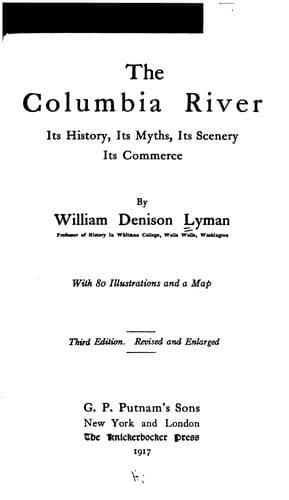
The Columbia River: Its History, Its Myths, Its Scenery, Its CommerceLyman, William Denison
History
The Columbia River: Its History, Its Myths, Its Scenery, Its Commerce
Lyman, William Denison
Columbia River; Columbia River -- Description and travel; Columbia River -- History
Since that time there have been few steamboats on that part of the River
above The Dalles. The section between The Dalles and the Cascades was
joined to the tide-water section by the opening of the Government locks at
the Cascades in 1896, and since that time many of the finest steamers on
the River do an immense tourist business between The Dalles and Portland.
It is only a question of a few years till the locks at Celilo will be
completed, and then the whole vast Inland Empire, with its enormous
production, will be thrown open to the sea. Then there will come on a new
age of steamboat navigation, and with it the electric railroad. The
steamer and the trolley car will set the whole Columbia Basin next door to
tide-water. When improvements now in view by Government are completed, our
River will be one of the most superb steamer courses in the world. That
may truthfully be said already of the two hundred and twenty miles from
The Dalles to the Ocean, as well as of the three hundred miles from Kettle
Falls, Washington, to Death Rapids, B. C.
The Government engineers in Senate Document, 344, February, 1890, name the
amount of navigable water on the Columbia and its tributaries at 1664
miles. This may, perhaps, be an underestimation, since President Roosevelt
has recently referred to it as twenty-five hundred miles, in which he
probably included the lakes. Generally speaking, the rivers of the Pacific
slope descend from high altitudes in comparatively short distances, and
are necessarily swift. Hence we can expect no such vast extent of
navigable water on them as the Mississippi and its affluents offer. Aside
from the Columbia itself, the main streams, east of the Cascade Mountains
offering steamboat transportation, are the Snake, Okanogan, and Kootenai,
together with Lakes Pend Oreille, Chelan, Coeur d'Alene, Flathead,
Okanogan, Kootenai, Arrow, Christina, and Slocan. On the west side are the
Willamette, Cowlitz, and Lewis rivers.
It would fill a volume to narrate even a tithe of the thrilling tales of
daring and tragedy which gather around the subject of boating in all its
forms on the Columbia.
One of the most remarkable steamboat journeys was that elsewhere described
in this work, under command of Captain F. P. Armstrong, of the _North
Star_, from Jennings, Montana, on the Kootenai to Canal Flats and thence
through the canal to Lake Columbia. With that should be coupled as equally
daring and more difficult, the trip down Snake River, from the Seven
Devils to Lewiston, in a steamer piloted by Captain W. P. Gray.
Public-domain text, read in full here on John Shaqi.
Reviews
Reviews
No reviews yet
Be the first to share your thoughts on this work.
Elsewhere in the archive
Join the Discussion
Join the discussion
Sign in to leave a comment or review.
Sign InorCreate an account